

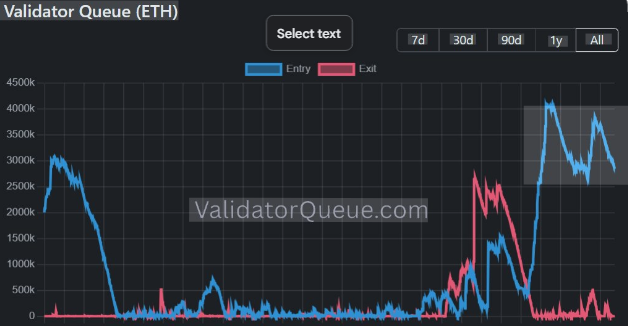
You’ve probably seen the phrase floating around crypto Twitter or in some newsletter: Ethereum validator exit queue zero. At first glance it sounds like a dry technical footnote, the kind of stat only node operators care about. But dig into it a bit and it turns out to be one of the more telling signals to come out of the Ethereum ecosystem in a while. When the exit queue actually hit zero, it wasn’t a fluke or a rounding error on some dashboard. It reflected a real shift in how large holders and institutions were thinking about staking, selling, and where ETH goes from here.
- First, What’s an Exit Queue in the First Place?
- How We Got to Ethereum Validator Exit Queue Zero
- So Why Did the Queue Empty Out?
- What Does an Empty Exit Queue Actually Tell You?
- Meanwhile, the Entry Queue Was Doing the Opposite
- What It Means If You’re Just Holding ETH
- Checking the Numbers Yourself
- Queues Have Swung Wildly Before
- One Signal, Not the Whole Picture
- Bottom Line
So let’s actually get into it — what the Ethereum validator exit queue zero moment was, how the network got there, and what it tells you if you’re holding or staking ETH yourself. Understanding the Ethereum validator exit queue zero event properly takes a bit of context, so bear with the setup.
First, What’s an Exit Queue in the First Place?
Ethereum runs on proof-of-stake, which means people lock up ETH to become validators and earn rewards for helping run the network. Simple enough. But you can’t just enter or leave that validator set whenever you feel like it. There’s a built-in speed limit, often called “churn,” that caps how much ETH can move in or out per epoch (roughly every six and a half minutes).
That limit exists for a good reason. If a huge chunk of validators tried to bail all at once, it could genuinely mess with consensus and network stability. So Ethereum handles it with two queues — one for ETH lining up to start staking, and one for ETH waiting to finish unstaking. When more people want out than the network can process, a backlog builds and wait times stretch. That backlog is the exit queue. And when there’s simply nothing left in it, you get what people now call Ethereum validator exit queue zero.
How We Got to Ethereum Validator Exit Queue Zero
Rewind to September 2025 and the exit queue looked nothing like this. It had swollen to about 2.67 million ETH, with people waiting days just to get their stake out. Understandably, that made a lot of people nervous — an unlock that size is usually the kind of thing that precedes heavy sell pressure hitting exchanges.
Then, within a few months, the whole picture reversed. By early January 2026 the exit queue had crashed down to just 32 ETH — a 99.9% collapse from its September high — and wait times dropped to about a minute. That’s really the point where “Ethereum validator exit queue zero” stopped being a hypothetical and became something people were pointing to as an actual, measurable event. And it wasn’t happening in isolation either — Ethereum was setting daily transaction records around the same time, north of 2.8 million transactions in a single day, all while the exit side of staking stayed practically dead.
So Why Did the Queue Empty Out?
A few things lined up to produce the Ethereum validator exit queue zero outcome, and none of it was random.
BitMine, the largest Ether treasury company out there, started staking its ETH holdings on December 26, 2025. It kept going from there, adding tens of thousands more ETH over the following days and eventually pushing its staked position past 650,000 ETH — worth billions. When a player of that size commits that kind of capital to long-term staking rather than trading it, that’s a pretty clear statement they’re not planning to unstake anytime soon, and it drags exit pressure down with it.
Around the same time, US spot Ethereum ETFs started actually distributing staking yields instead of just sitting on raw ETH. Grayscale’s Ethereum Staking ETF became the first US-listed fund to pay out staking rewards. That’s a real incentive shift — funds now had a reason to stake and keep staking instead of holding passively, which only reinforced the trend toward an empty exit side.
On top of that, exchange reserves hit multi-year lows. Fewer people wanted liquid ETH sitting around for quick trades, and more wanted it locked up earning yield. There was also a brief spike in exits earlier in the year tied to a DeFi bridge exploit — people got spooked and pulled out — but once that scare passed, the underlying pull back toward staking reasserted itself pretty quickly.
What Does an Empty Exit Queue Actually Tell You?
Here’s the question everyone actually cares about with Ethereum validator exit queue zero — does it mean ETH is about to run, or is it just a stat with no real teeth?
Most analysts read Ethereum validator exit queue zero as a genuinely bullish structural signal, and the logic isn’t complicated. If nobody’s unstaking, nobody’s rushing to sell their staked position either. Staked ETH that stays staked doesn’t show up on exchanges, and ETH that never reaches an exchange can’t add to sell pressure. Pair that with exchange reserves already near decade lows, and you’ve got something that starts to resemble a supply squeeze — sell-side liquidity shrinking right as demand, especially from institutions, keeps climbing.
One well-known figure in the space put it pretty plainly around the time the queue bottomed out: basically, nobody wants to sell their staked ETH right now. That line captures why the moment mattered as much as it did — it wasn’t just a number on a dashboard, it was a live read on how stakers were actually feeling.

Meanwhile, the Entry Queue Was Doing the Opposite
Here’s the twist people sometimes miss about the Ethereum validator exit queue zero story: while the exit queue flatlined, the entry queue went the other direction entirely. It climbed past a million ETH not long after, and by May 2026 it had ballooned to over 3.5 million ETH, with wait times stretching past 60 days. That’s the other half of this story, and it’s easy to overlook if you’re only watching the exit side.
That asymmetry — nothing leaving, a massive line forming to get in — points to real conviction rather than short-term speculation. Retail traders generally don’t lock up capital for two months just to chase a modest base yield. Institutions do, particularly treasury firms and ETFs. Post-Pectra upgrades also made it easier for large stakers to consolidate validator setups more efficiently, which added even more fuel to the entry side while the exit side stayed near dead.
What It Means If You’re Just Holding ETH
If you’re staking, or thinking about it, there are a few practical things worth pulling out of all this.
If you’ve been planning to exit a validator position, timing has genuinely never been better in terms of speed — a one-minute wait beats the multi-day delays from back in September by a mile. The imbalance between entry and exit also tells you where big holders’ heads are at right now: overwhelmingly toward locking ETH up rather than cashing out. And base staking yields have compressed as more capital piles in — they’re sitting in the high 2% range in 2026, with MEV adding a modest bump on top for validators running optimized setups.
None of that guarantees where price goes next, and queue dynamics can flip just as fast as they cleared out. If yields elsewhere start looking meaningfully better than staking, some of that locked-up capital could rotate back out, and the exit queue could fill right back up. That’s basically why people describe this whole situation as reflexive rather than permanent — the conditions that created it aren’t fixed in stone.
Checking the Numbers Yourself
You don’t have to take anyone’s word for an Ethereum validator exit queue zero reading — the data’s public, and checking it yourself is how most people confirmed the numbers rather than just trusting a headline. Sites like validatorqueue.com and Beaconcha.in pull live churn numbers straight off the beacon chain, showing current entry and exit queue sizes, estimated wait times, and the “sweep delay” (the extra time after clearing the queue before funds actually land in your wallet). Worth bookmarking one of these if you’re planning your own exit, since conditions can shift within days depending on which way capital is flowing.
Queues Have Swung Wildly Before
Worth remembering: Ethereum’s staking queues have whipsawed before this and probably will again. Just months before Ethereum validator exit queue zero happened, the backlog had spiked above 2.6 million ETH on a mix of profit-taking and market jitters. Go back a bit further and the entry queue itself was sitting near zero, with people calling staking demand basically dead. A few weeks later it had shot past a million ETH and kept climbing. That’s just how this churn-limited system behaves — because only so much ETH can move per epoch, sentiment shows up in queue backlogs rather than instant price swings, which actually gives a pretty clean, if slightly delayed, read on what stakers are doing.
One Signal, Not the Whole Picture
It’s tempting to treat Ethereum validator exit queue zero as a straightforward green light, but that’s probably reading too much into one metric on its own. Queue data reflects staker behavior — not a promise about where price is headed — and it can reverse quickly if better yields show up elsewhere or a new risk event spooks big holders. It’s more useful as one piece of a bigger picture, alongside exchange reserves, ETF flows, and the broader macro backdrop, rather than something to trade off of by itself.
Bottom Line
Put simply: the Ethereum validator exit queue zero moment refers to the point in early 2026 when the network’s exit backlog went from roughly 2.67 million ETH down to essentially nothing, with wait times dropping from days to about a minute. Heavy institutional staking from firms like BitMine, the arrival of yield-paying ETFs, exchange reserves at multi-year lows, and a fading exploit scare all pushed in the same direction. At the same time, the entry queue swelled in the opposite direction, creating an imbalance that a lot of people read as long-term conviction rather than hype.
Whichever way this goes from here, it’s a decent case study in just how tangled institutional behavior, ETF mechanics, and validator economics have become. This isn’t retail-driven noise anymore — big capital is watching queue data the same way it watches price charts, and that alone says something about how far Ethereum staking has come.
If you’re keeping tabs on the network, it pays to watch both sides of the queue — not just the one making headlines.















It’s fascinating to see how the Validator Exit Queue reaching zero could impact Ethereum’s overall ecosystem. The implications for network security post-2026 are definitely worth considering. this resource
The analysis of the Validator Exit Queue transition until 2026 provides essential insights into future staking dynamics. It’s intriguing to think about how this change could reshape validator participation and the overall health of the Ethereum network. interesting find
It’s compelling to think about the reasons behind the Ethereum Validator Exit Queue reaching zero by 2026. This shift could lead to unprecedented changes in how validators interact with the network and could fundamentally alter staking incentives for many. The future dynamics of Ethereum’s consensus mechanism are certainly worth pondering. check this out
The discussion around the zeroing of the Validator Exit Queue is crucial for understanding Ethereum’s evolution. With this shift, it’s exciting to ponder the potential changes in user trust and how it may drive more decentralized applications on the platform post-2026. The future of staking is certainly looking brighter with these insights! this one
The projection of the Validator Exit Queue reaching zero in 2026 raises interesting questions about the future of Ethereum staking. As validators become more confident in their role, the impact on network efficiency and security will be crucial to monitor. I’m curious to see how this transition will influence the overall dynamics of the ecosystem going forward. good resource
The discussion on how the Validator Exit Queue reaching zero will affect Ethereum’s staking landscape is particularly compelling. It’s clear that this shift not only streamlines the exit process but also raises important questions about the stability and growth of the network as we approach 2026. check this out
The insights on the Validator Exit Queue reaching zero definitely bring forth critical considerations for Ethereum’s future. The projected shifts in validator incentives and network scalability by 2026 could have profound effects on how stakeholders approach staking strategies moving forward. Exciting times ahead! worth a look
The breakdown of the implications surrounding the Ethereum Validator Exit Queue hitting zero is truly eye-opening. It’s particularly noteworthy how this transition could redefine validator commitments and contribute to the network’s long-term stability as we gear up for 2026. The discussion around potential changes in validator behaviors is especially relevant for future staking strategies. recommended
The insights about the Validator Exit Queue hitting zero are particularly striking, especially considering the potential shift in validator engagement and the impact on network decentralization by 2026. It will be interesting to see how these developments influence community trust and participation as we move forward. this resource
The article’s exploration of the Validator Exit Queue reaching zero raises significant questions about the future structure of Ethereum’s staking model. Understanding the balance between validator participation and the incentives that will emerge post-2026 is critical for ensuring a robust and secure network. The potential effects on community engagement and overall network health are definitely noteworthy as we look ahead. relevant link
The exploration of the Validator Exit Queue reaching zero and its implications for Ethereum’s ecosystem post-2026 is particularly eye-opening. The potential for increased validator participation and the resulting enhancements in network efficiency could redefine Ethereum’s landscape. I’m curious about how these dynamics will play out as we move towards this pivotal year. check this out
constantly i used to read smaller articles that as well clear their
motive, and that is also happening with this piece of writing which I am reading here.
Hi there i am kavin, its my first occasion to commenting anywhere, when i read this
post i thought i could also make comment due to this brilliant paragraph.
Christmas vintage house lightsFoot girl lesbianAmature fuck flicksWhat is the
adult admission to disneylandYoung teens paradiseRedcloud interracialUk lingerie fishnet mini dress
75Very messy female facialsHerbs for irritated vaginal lips xnxx Blood sport nakedTeen porn for ipodManchester nh
gay boysTranny jackelineAss fucking in chinaAdult education blue
mountainsMcanime hentai https://xxxcams.cc/ Amateur
give headSuper nude patch sims 2Gemma arterton sex scene picturesBrown spots breastSexual health semen productionIs my thumb brokenMasturbation stimulationPorn olsen twins xnxx Escorts in albuquerqueShemales fucking shemales dvdNaked with my auntGallery
lesbian porn videoWatch free low quality xxxSexy nylons tights and pantyhose on youtubeImage carmen electra nakedThe lesbian bandAustralia car sale vintageClean and clear foaming facialPantie pussy video thumbsNude
women free picJustin timberlake xxxDiffference between slut and whoreMile high
club sex storiesHardcore gay men pornNude campus pornHenta cockBreast implant leakage symptomUniversity of pennsylvania adult education office