
Most people who first hear about Geron Corporation (Nasdaq: GERN) do a double take. The stock trades for just over a dollar. The company has been around since 1990. And yet, right now in 2026, some of the most respected names on Wall Street are putting price targets on it that are three, four, even five times its current value. So what exactly is going on with GERN — and is the GERN stock forecast 2030 as exciting as the bulls claim?
- First, What Does Geron Actually Do?
- Where Things Stand in 2026
- Why Is the Stock So Cheap If the Business Is Growing?
- What Analysts Are Saying About GERN Stock Forecast 2030
- The Catalysts That Will Actually Drive the GERN Stock Forecast 2030
- The Risks You Cannot Ignore
- So, Is GERN Worth Holding Until 2030?
Let’s dig into it honestly, without hype.
First, What Does Geron Actually Do?
Geron Corporation is a biotech company focused entirely on blood cancers. It does not try to do everything — it has one approved drug, one core mechanism, and a clear clinical pipeline built around that mechanism.
That drug is called RYTELO, the brand name for imetelstat. It is a telomerase inhibitor, which is a genuinely novel class of treatment. Here is the simple explanation: cancer cells survive longer than normal cells because they have an enzyme called telomerase that keeps rebuilding the protective ends of their chromosomes. RYTELO blocks that enzyme, which stops the abnormal cells from multiplying indefinitely.
RYTELO became the world’s first approved telomerase inhibitor. It is currently approved in the United States and the European Union for adults with lower-risk myelodysplastic syndromes (LR-MDS) — a progressive blood cancer where patients often become dependent on red blood cell transfusions because their bone marrow is not producing enough healthy cells on its own.
That approval alone changed Geron from a development-stage company into a commercial-stage business. And that shift is the foundation of every serious GERN stock forecast 2030 conversation.
Where Things Stand in 2026
Before looking at 2030, you need to understand where the company is right now, because the trajectory matters.
In 2025, Geron posted total revenue of $183.88 million — a jump of nearly 139% from the $76.99 million it earned in 2024. Losses for the year shrank to $83.5 million, more than half the losses from the year before. In Q1 2026 alone, the company reported $51.84 million in net revenue, beating analyst estimates and showing 31% year-over-year growth. US demand for RYTELO rose 6% sequentially in that same quarter.
Management has guided for $220 to $240 million in full-year 2026 revenue, and they have $341 million in cash on hand. Wedbush and Needham both maintained Buy ratings in early 2026. TD Cowen issued a Buy as well. Even with Goldman Sachs holding a dissenting Sell rating, the overall picture from Wall Street is clearly more positive than negative.
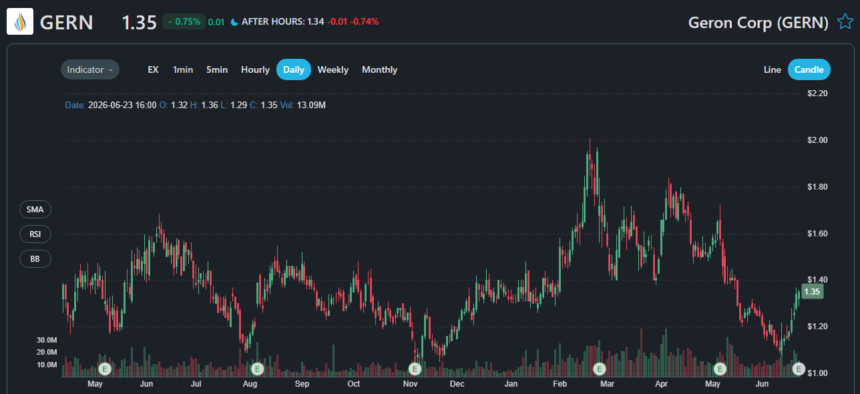
The stock itself, however, is still trading around $1.20 to $1.70, which is where the opportunity — and the tension — exists for anyone thinking about the GERN stock forecast 2030.
Why Is the Stock So Cheap If the Business Is Growing?
This is the question every serious investor asks. And it has a real answer.
Geron is still not profitable. Despite the revenue growth, the company is still operating at a loss, partly because of the costs associated with building out a commercial team, running multiple clinical trials, and expanding into Europe. Biotech investors get nervous about cash burn, and that nervousness keeps a lid on the stock price.
There is also uncertainty around the pipeline. The most important near-term catalyst is the Phase 3 myelofibrosis trial called IMpactMF, and the interim data from that trial is expected in the second half of 2026. If that data disappoints, it could hit the stock hard. If it impresses, the story changes completely.
That uncertainty is exactly what creates the gap between where GERN trades today and where analysts think it could go. The GERN stock forecast 2030 essentially asks: by 2030, will the myelofibrosis program succeed, will the European revenue ramp, and will the company finally reach profitability?
What Analysts Are Saying About GERN Stock Forecast 2030
Here is where it gets interesting.
For the next 12 months alone, the analyst consensus points to major upside. TipRanks reports a Strong Buy consensus based on analyst ratings, with an average 12-month price target of $4.00, a high of $5.00, and a low of $3.00. Given GERN’s current price near $1.68, that average target represents roughly 138% upside in under a year.
Stock Analysis aggregates data from six analysts who collectively rate GERN a Buy, with an average 12-month target of $3.40. Tickernerd puts the median Wall Street target at $4.00. Fintel’s compilation of analyst forecasts shows an average one-year target of $3.23, with the highest estimate reaching $5.25.
For longer-term projections specifically tied to the GERN stock forecast 2030, the numbers are even more striking. StockScan projects the stock could reach approximately $6.47 by 2030, based on financial modeling of the company’s growth curve. On the higher end, some Wall Street-compiled models put the 2030 trading range between $3.16 and $15.80. That is a wide range, and it reflects the genuine uncertainty around clinical outcomes.
Simply Wall St analysts have pointed out that Geron is expected to become profitable in 2027, with average annual earnings growth of around 72% required to hit that target on schedule. Revenue is forecast to grow at roughly 31% per year over the next three years — well above the 21% industry average for US biotech companies.
If those growth rates hold through 2030, the math behind a significantly higher share price becomes a lot easier to understand.
The Catalysts That Will Actually Drive the GERN Stock Forecast 2030
No single article can predict what the stock will do. But there are specific events that will matter most:
IMpactMF Interim Data (H2 2026) This is the biggest near-term catalyst. The Phase 3 trial of imetelstat in myelofibrosis could unlock a patient population significantly larger than the current LR-MDS market. A positive interim readout would almost certainly push the stock sharply higher. A negative one would do the opposite. This one event alone could define where GERN trades by 2027.
European Commercial Ramp RYTELO received EU marketing authorization in March 2025, and the EU approval came with orphan drug designation — meaning ten years of market exclusivity after approval. Patent protection in the EU is expected to extend into 2038. The European commercial rollout is still early. As that revenue stream builds over the next four years, it adds meaningful weight to any GERN stock forecast 2030 model.
Real-World Evidence Building In May 2026, Geron announced the first real-world evidence study of RYTELO in LR-MDS patients, conducted at the Moffitt Cancer Center. The study showed a 37.5% rate of red blood cell transfusion independence lasting at least eight weeks — consistent with the Phase 3 IMerge trial data. Real-world evidence like this matters because it gives community physicians the confidence to prescribe beyond what they already know from trial results.
Path to Profitability The company is expected to break even in 2027. Once it is generating genuine profits, it becomes a different kind of investment — one that attracts income-focused and growth-and-income investors who would never touch a loss-making biotech. That broadening of the investor base tends to support a higher share price and lower volatility.
AML and Additional Pipeline Data Geron has early-stage programs in acute myeloid leukemia (AML) through its IMAGINE trial. If the data there looks promising, it adds another potential growth leg beyond 2027. AML is a serious, fast-moving blood cancer with limited treatment options for patients who have relapsed after prior therapy.
The Risks You Cannot Ignore
An honest GERN stock forecast 2030 article has to talk about what could go wrong.
The most obvious risk is clinical failure. If IMpactMF comes back negative, the myelofibrosis opportunity disappears, and the company becomes a single-indication commercial business rather than a platform. That would compress the stock’s valuation considerably.
Commercial execution is the second risk. RYTELO’s LR-MDS market is real but requires constant physician education and patient identification. Competition from other treatments is growing, and any slowdown in adoption could delay the path to profitability further.
Dilution risk is also real. Geron filed an at-the-market offering of up to $150 million in common stock in early 2026. Raising capital this way avoids a single massive dilutive event, but it means new shares are steadily being issued, which can put downward pressure on the stock price.
Finally, Goldman Sachs has maintained a Sell rating with a $1.00 price target — a firm reminder that not everyone sees the story the same way. Their concern centers on execution risk and valuation. Investors should read both sides before making any decision.
So, Is GERN Worth Holding Until 2030?
That depends entirely on what kind of investor you are.
If you are comfortable sitting through volatility and binary clinical events, and if you believe imetelstat has a future beyond LR-MDS, then the GERN stock forecast 2030 offers a genuinely compelling case. The company has a first-in-class approved drug, growing revenue, a funded pipeline, dual US and EU approvals, and a management team that has publicly committed to reaching profitability in 2027.
If the myelofibrosis program delivers positive data in late 2026, and if the European market continues to ramp, and if profitability arrives on schedule — the stock at $1.20 to $1.70 today could look like a very different value by 2030.
But if any of those assumptions prove wrong, the road to 2030 will be bumpy, and the returns may not justify the risk you took on.
The GERN stock forecast 2030 is ultimately a story about one of the most scientifically interesting mechanisms in oncology — telomerase inhibition — finally getting its chance to prove itself in the real world. Whether the stock reflects that by 2030 depends on execution, clinical results, and a bit of luck. Those three things rarely travel together in perfect formation, but when they do, small-cap biotechs like GERN are where life-changing returns are made.