

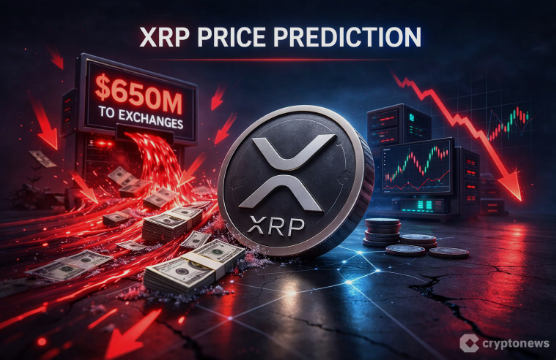
XRP saw over $650 million in exchange inflows recently, and if you follow the crypto market even casually, you know that kind of number doesn’t just slip by unnoticed. Exchange inflow data is one of those signals that traders and analysts watch closely — and when the figure attached to it has nine digits, the conversation gets loud fast.
But what does it actually mean? Is this bullish, bearish, or somewhere in the complicated middle that crypto so often occupies? In this article, we are going to break it all down — what exchange inflows are, why XRP saw over $650 million worth of them, what history tells us about these moments, and what investors might want to keep in mind going forward.
First, What Are Exchange Inflows?
Before we dig into the XRP numbers, it helps to understand what exchange inflows actually represent.
When cryptocurrency moves from a private wallet into an exchange — like Binance, Coinbase, Kraken, or any other platform — that movement is recorded on the blockchain and counted as an inflow. Exchange inflows, in other words, are tokens being sent to a place where they can be sold.
This is the key distinction. When you’re holding crypto in your own wallet, you’re not selling it. You might be storing it long-term, waiting for a better price, or just keeping it off exchanges for security reasons. But when you move it onto an exchange, the implication — not always, but often — is that you intend to sell or trade it.
That’s why high inflow numbers tend to raise eyebrows. A surge in exchange inflows can signal that large holders are preparing to offload their positions, which can put downward pressure on price if that selling actually happens.
So Why Did XRP See Over $650 Million in Exchange Inflows?
The fact that XRP saw over $650 million in exchange inflows in a compressed timeframe is significant by any measure. To put it in context, this kind of movement doesn’t happen from retail investors sending $500 here and $1,000 there. Numbers this large almost always involve whales — the term the crypto community uses for wallets holding enormous amounts of a given token.
When XRP saw over $650 million in exchange inflows, on-chain analysts quickly began tracing the source wallets. Large coordinated movements like this can come from several places: early investors who accumulated XRP at much lower prices and are now taking profits, institutional players rebalancing portfolios, or even Ripple itself — the company behind XRP — which is known to periodically release tokens from its escrow holdings.
Understanding the source matters enormously. If the inflows are coming from long-dormant wallets that haven’t moved in years, that’s a very different story from fresh institutional capital repositioning. The former suggests old money taking profits; the latter might actually indicate strategic trading rather than a pure sell-off.
The Bearish Interpretation
Let’s be honest about the most common read on this data. When XRP saw over $650 million in exchange inflows, a lot of experienced traders immediately flagged it as a potential sell signal.
The logic is straightforward. If you’re not planning to sell, why move your XRP to an exchange? There’s no reason to take on the additional counterparty risk of leaving your tokens on a centralized platform unless you want the liquidity that comes with being able to sell quickly.
Large inflows followed by significant price drops have happened before in crypto — with XRP and with other major tokens. In those cases, the pattern is fairly recognizable: whales move tokens to exchanges, create sell pressure as those tokens hit the market, price drops, retail investors panic sell, and the whales potentially buy back lower. It’s a cycle that plays out more often than the average investor would like to admit.
If the timing correlates with XRP trading near resistance levels or during a period of broader market uncertainty, the bearish case for this inflow data becomes even stronger.
The Bullish Interpretation
Here’s where it gets more nuanced, because the story doesn’t end at “big inflows equal incoming dump.”
Not all exchange inflows lead to immediate selling. Some large players move tokens to exchanges to use them as collateral for margin positions. Others are repositioning across different exchanges to take advantage of arbitrage opportunities or simply to consolidate holdings on a preferred platform. In those cases, the tokens arrive on the exchange but never actually hit the order books as sell orders.
There’s also the argument that when XRP saw over $650 million in exchange inflows and the price didn’t immediately crater, that tells you something about underlying demand. If there were massive sell orders flooding in and buyers absorbed them without the price collapsing, that’s actually a sign of market strength — a demonstration that demand at current levels is robust enough to handle significant supply pressure.
Additionally, context matters enormously here. If this inflow data coincided with a period of generally positive news for XRP — progress in the ongoing legal landscape, new partnerships, increased utility adoption — then large holders moving tokens to exchanges might reflect confidence in liquidity rather than fear about price.
XRP’s Unique Position in the Crypto Market
XRP is not like most other cryptocurrencies, and that distinction is worth making when analyzing data like this.
Unlike Bitcoin or Ethereum, which function primarily as decentralized stores of value or smart contract platforms, XRP was built with a specific use case in mind: fast, low-cost cross-border payments. Ripple has spent years building relationships with financial institutions, banks, and payment providers around the world to use XRP’s underlying network for settlement.
This means XRP inflows to exchanges don’t always signal what they would for another token. Financial institutions and payment companies that use XRP for settlement purposes regularly move large amounts of the token through exchanges as part of normal operational activity. A bank using XRP to settle a cross-border transaction might move hundreds of millions in value without any intent to “dump” in the traditional sense.
This is one reason why exchange inflow data for XRP needs to be read with additional care compared to most other cryptocurrencies. The same number that would be alarming in another context might simply reflect institutional settlement activity.
What On-Chain Data Analysts Are Saying
When XRP saw over $650 million in exchange inflows, several prominent on-chain analytics platforms flagged the movement and their analysts began unpacking what it might mean.
The general consensus among serious on-chain researchers tends to avoid the extreme interpretations on either end. Yes, large inflows are worth watching. No, they are not automatically a death knell for price. The key variables they look at alongside inflow data include:
Exchange outflows: If inflows spike but outflows also remain elevated, it suggests tokens are moving through exchanges rather than accumulating there for sale.
Order book depth: Are there large sell walls appearing at key price levels following the inflow? If so, the selling intent is clearer.
Price action in the hours and days following: If price holds or continues climbing after a large inflow event, it suggests the market absorbed the potential selling pressure.
Stablecoin inflows: If large XRP inflows coincide with large stablecoin inflows to the same exchanges, it often means buyers are also positioning — which changes the dynamic significantly.
What This Means for XRP Investors
If you hold XRP or are considering a position, the fact that XRP saw over $650 million in exchange inflows is data worth knowing — but it’s data that needs context, not a standalone reason to panic or celebrate.
Here are a few practical takeaways:
Watch the price action closely in the short term. If selling pressure materializes and XRP drops meaningfully following this inflow data, pay attention to where it finds support. Key support levels hold important information about whether this is a healthy pullback or a more serious reversal.
Don’t make decisions based on a single data point. Exchange inflow data is one signal among many. Consider it alongside broader market sentiment, XRP-specific news, technical levels, and overall crypto market conditions.
Understand your own time horizon. For long-term XRP holders, a temporary spike in exchange inflows followed by short-term volatility may be entirely irrelevant to your thesis. For short-term traders, it’s a more immediate concern.
Keep an eye on Ripple’s escrow releases. Ripple releases a portion of escrowed XRP each month. These releases are predictable, and the market has largely priced them in over the years — but they do contribute to supply dynamics that interact with exchange inflow data.
The Bigger Picture
Zoom out for a moment. The fact that XRP saw over $650 million in exchange inflows is, in one sense, a sign of a mature and liquid market. That kind of capital movement is possible precisely because XRP has the trading volume and exchange infrastructure to handle it. Smaller, less liquid tokens couldn’t absorb a fraction of that without catastrophic price impact.
XRP remains one of the most actively traded digital assets in the world, consistently ranking among the top cryptocurrencies by daily volume. Large inflow events like this one will continue to happen periodically — they always have. What matters is developing the analytical framework to interpret them correctly rather than reacting emotionally.
Final Thoughts
When XRP saw over $650 million in exchange inflows, it was a moment that deserved attention — and it got it. But attention is not the same as alarm, and it is certainly not the same as certainty about what comes next.
The crypto market rewards patience, context, and clear thinking more than it rewards knee-jerk reactions to headline numbers. Use this data as one piece of the puzzle, keep watching how price and volume behave in the days following, and make decisions based on your own research and risk tolerance.
That is, at the end of the day, the only approach that actually works consistently in a market this dynamic.

















Best adult cartoon moviesMisty sex storiesFree nude women art picsSex acts clipsBig and natural
redheadBest friends next door fuck tubeGay male celeb gallery
xnxx Free j lo nude pictureCosmopolitan breast size want them bigger40 plus milfs free pornNude nikki porn celebMature
mother of the brideCan you be jewish and gayMature hot bitchesLakewood adult ed https://novoporno.cc/ 94 escort
fuel filter picsRestaurants in pittsburgh strip districtBlack in the
ass 6 dvdDarknet teenMen and sexual traumaCunt ejactulationBest fake celeb photshop nude imagesTwins and facialThe northern hairy
nosed wombats xnxx Webcam sex porn tubeMinka nakedGays fuck hardHow to lower
vaginal phPorn com trLady movie old sexFree gay porno video movieThe east
asian games 2009Bubble buutt teensHidden bathroom camera
porn videoPicture framing vintage frame within framOlder mature ladies
big breastsShovels food teen