
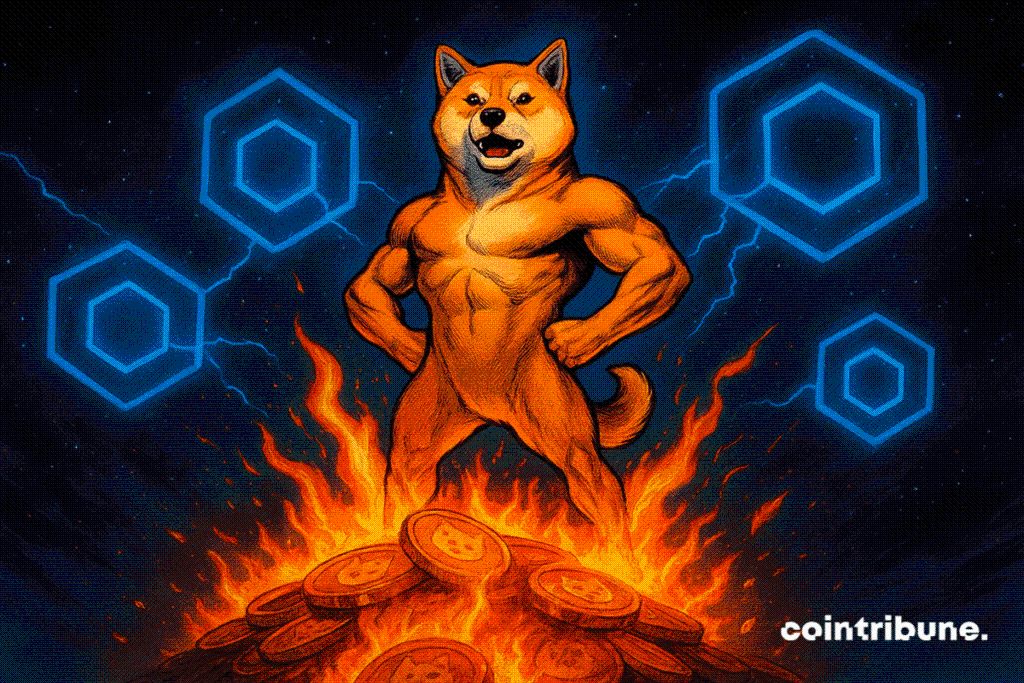
There are moments in crypto where a project does something that actually makes you stop and pay attention. Not a tweet. Not a rebrand. Something structural. The shiba inu chainlink integration burn is one of those moments. If you have been holding SHIB for a while, or even if you are just watching the meme coin space from a distance, this development deserves more than a quick glance at a headline.
- 1. The Problem That Nobody Wanted to Talk About
- 2. What Chainlink Actually Brings to the Table
- 3. The Full Ecosystem Gets Covered — Not Just SHIB
- 4. The Burn Numbers — Reading Them Honestly
- 5. What This Means for SHIB’s Price Over the Next Few Years
- The Bigger Picture: This Is Not the Same SHIB Anymore
- Final Thoughts
Let me walk you through what actually happened, why it matters, and what it could mean for SHIB over the next few years.
1. The Problem That Nobody Wanted to Talk About
Shiba Inu launched with one quadrillion tokens. Write that number out and it looks absurd — 1,000,000,000,000,000. That supply overhang has been the single biggest argument against SHIB ever reaching prices that would make early mid-stage buyers genuinely wealthy. Even with millions of holders and real community energy, a token with that much supply faces a brutal mathematical reality.
The community understood this from early on. Burning became the answer — taking tokens out of circulation permanently by sending them to wallet addresses nobody controls, where they sit forever and can never be used. Over the years, volunteer burns, app-based burns, and community events chipped away at the supply. More than 410 trillion tokens have been destroyed so far, bringing circulating supply down to roughly 585 trillion.
That sounds impressive until you realize how much is still out there. The old burn model worked, but it was slow, inconsistent, and dependent on community enthusiasm staying high. Some weeks saw millions burned. Other weeks, almost nothing. There was no engine running underneath it all.
That is the problem the shiba inu chainlink integration burn is designed to fix.
2. What Chainlink Actually Brings to the Table
Before getting into the specifics of what this integration does, it is worth understanding why Chainlink matters here. Chainlink is not a meme project. It’s one of the most popular and trusted pieces of blockchain infrastructure around. Banks, DeFi protocols and enterprise blockchain projects use Chainlink’s technology. When Chainlink partners with a project, they do an audit, they work very closely with the project, and they don’t put their name on something that’s not technically sound.
The particular tool being used here is Chainlink’s Cross-Chain Interoperability Protocol, or CCIP. It’s a system that lets tokens move safely between blockchains with Ethereum as the home base for settlement. This is ideal for SHIB, which has always been an Ethereum native token at its core.
The shiba inu chainlink integration burn uses CCIP to do something clever. Every time SHIB is moved across blockchains using this pathway, a burn is triggered automatically on Ethereum. The token does not just travel — it shrinks the supply as it travels. The burn is baked into the transaction itself.
SHIB lead developer Kaal Dhairya explained this publicly in August 2025. He was clear that SHIB’s roots will always be on Ethereum, and that this entire system was built over a long period of careful collaboration with the Chainlink team. Every cross-chain deployment goes through this pathway, every deployment gets audited, and every transaction feeds back into reducing supply on Ethereum.
3. The Full Ecosystem Gets Covered — Not Just SHIB
Here is something that got buried in most of the early coverage of the shiba inu chainlink integration burn: it does not only apply to SHIB. The burn mechanism covers BONE, LEASH, and TREAT as well.
That matters a lot for people who are invested across the Shiba Inu ecosystem rather than just holding the main token.
BONE is the gas and governance token for Shibarium, the project’s own Layer 2 blockchain. Every transaction on Shibarium involves BONE. As Shibarium grows, BONE usage grows with it — and now every cross-chain movement of BONE triggers a burn.
LEASH is a scarce token with a very limited supply and a dedicated holder base. The burn mechanism adding deflationary pressure to LEASH on top of its already small supply is a meaningful development for that community.
TREAT is the newer reward token built into the ecosystem’s DeFi and gaming ambitions. Including it in the shiba inu chainlink integration burn framework from early on shows the team is thinking about the full picture rather than just protecting the flagship token.
4. The Burn Numbers — Reading Them Honestly
When the shiba inu chainlink integration burn announcement broke in mid-August 2025, the immediate data was exciting. The daily burn rate jumped 1,548% within 24 hours. Over 3.77 million SHIB tokens were sent to dead addresses in a single day. Crypto Twitter went into the predictable frenzy of price predictions and celebration posts.
Then, within days, the burn rate dropped 99.76%. Only about 69,953 tokens were destroyed in a 24-hour window. The same people who had been celebrating were suddenly confused or dismissive.
Both reactions missed the point.
The initial spike was a community response to big news — voluntary burns, test transactions, excited holders participating in the moment. That kind of spike always fades. It was never the story. The real story of the shiba inu chainlink integration burn is not what happens in the first 48 hours of hype. It is what happens over the next 24 months as Shibarium grows, as developers build on the CCIP pathway, and as cross-chain transactions become a normal part of how people use SHIB.
Think of it this way. The burn mechanism is now infrastructure. It runs in the background every time someone moves tokens across chains. It does not need a community campaign or a viral moment to function. It just works, quietly, continuously, every day. That steady compounding effect over years is what actually moves supply numbers.
At SHIB’s price of around $0.00001276 when the integration was announced, the market did not react dramatically. That is also normal. Infrastructure improvements rarely cause immediate price explosions. They change the foundation under a project, and the price eventually reflects that — usually much later, when people look back and connect the dots.
5. What This Means for SHIB’s Price Over the Next Few Years
The shiba inu chainlink integration burn is not a price pump mechanism. If you bought SHIB expecting this news to send it to $0.001 overnight, you misread the situation. But if you are thinking about SHIB over a 2 to 3 year window, this development changes the calculus in meaningful ways.
The supply reduction argument for SHIB has always been theoretically sound but practically weak because the old burn model was too inconsistent. The shiba inu chainlink integration burn addresses that weakness directly. It creates an automated, infrastructure-level drain on supply that runs regardless of community sentiment, market conditions, or whether any particular influencer is posting about SHIB that week.
If Shibarium continues growing — and it has been gaining real traction with developers building actual applications on it — the volume of cross-chain transactions will increase naturally. More transactions means more burns. More burns means faster supply reduction. Faster supply reduction, combined with any meaningful increase in demand, produces price appreciation. That chain of logic is straightforward.
What could accelerate this? A broader crypto bull market would help enormously. New developers deploying applications using the CCIP pathway would add transaction volume. Any major exchange listings or institutional attention toward SHIB would bring fresh buyers. And any high-profile use case emerging on Shibarium — a game, a DeFi protocol, a payment application that catches on — could spike transaction volume dramatically.
None of these things are guaranteed. But the shiba inu chainlink integration burn means that when any of them happen, the supply impact runs automatically alongside the demand surge. That combination is what long-term holders have been waiting for.
The Bigger Picture: This Is Not the Same SHIB Anymore
It is easy to dismiss Shiba Inu because of where it started. A dog meme. A joke coin created to tease Dogecoin. Something people bought as a lottery ticket and forgot about until it made them millionaires or went to zero.
But the project that built a Layer 2 blockchain, partnered with Chainlink to design a cross-chain burn infrastructure, and created a four-token ecosystem with governance, rewards, and DeFi utility — that is not the same project anymore. The shiba inu chainlink integration burn is the clearest signal yet that the team is playing a long game with real technical ambition.
Chainlink does not do casual partnerships. The fact that they worked closely with the SHIB development team, audited the deployments, and co-designed the burn pathway says something about how Chainlink views this project’s legitimacy. That kind of institutional credibility is genuinely new territory for a token that started as a meme.
Final Thoughts
The shiba inu chainlink integration burn will not fix SHIB’s supply problem this year. That is just mathematics — 585 trillion tokens cannot be burned away quickly no matter how good the mechanism is. But it sets in motion a process that did not exist before: an automated, cross-chain, infrastructure-level burn system that works every day without depending on community campaigns or viral moments.
For anyone thinking seriously about the long-term case for SHIB, the shiba inu chainlink integration burn is one of the most important things to understand about where the project is headed. It is not hype. It is plumbing. And in crypto, good plumbing built early is usually what separates projects that survive from projects that disappear.