
Let me start by admitting something. For a long time, I had written off UiPath.
- What UiPath Actually Does — And Why the Story Has Changed
- The Numbers Behind the Current Business
- What Analysts Are Actually Saying About the UiPath Stock Price Prediction 2030
- 7 Factors That Will Decide Where PATH Goes by 2030
- 1. The Agentic AI Transition Is Real — But Timing Is Everything
- 2. Microsoft Is Both a Partner and a Threat
- 3. The ARR Growth Rate Needs to Reaccelerate
- 4. The Valuation Reset Has Already Happened — Which Is Actually Good News
- 5. Enterprise AI Adoption Is Creating a Tailwind That Wasn’t There Before
- 6. Profitability Trajectory Changes the Investment Math
- 7. The WorkFusion Acquisition Tells You Where Management Is Betting
- The Honest Bull and Bear Cases
- My Honest Assessment
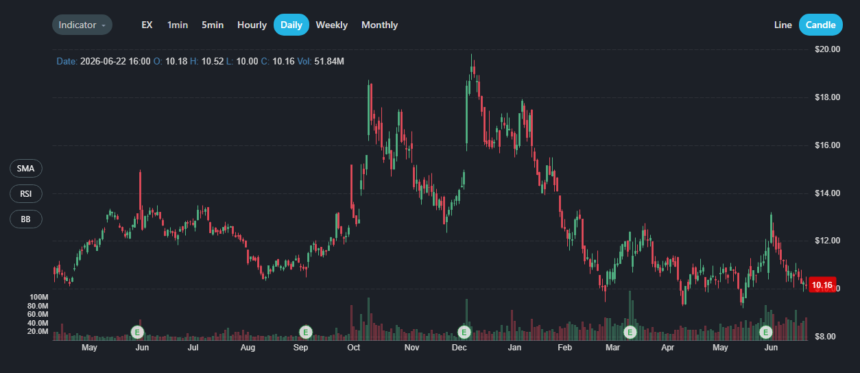
The stock hit $85 in May 2021. Then it spent the next three years getting absolutely crushed — all the way down to $9.38 in April 2025. That’s an 87% decline from peak. Billions of dollars of investor wealth, gone. If you were in the stock market during those years, it was genuinely painful to watch.
So when people ask me about the uipath stock price prediction 2030, my honest first reaction is complicated. Because this is a company that has both burned investors badly and built something genuinely interesting. Those two things can be true at the same time — and understanding both sides is what separates a thoughtful investment decision from a reckless one.
Let’s get into it.
What UiPath Actually Does — And Why the Story Has Changed
If you followed UiPath back in its early days, you probably know it as an RPA company. Robotic Process Automation. The idea was simple: software bots that mimic human actions on a computer screen — clicking buttons, copying data, filling forms — to automate repetitive work. It was a great idea, and UiPath executed on it well enough to become one of the largest enterprise software IPOs in US history.
But here’s the thing. The RPA story alone wasn’t big enough to justify the valuations the market gave this company in 2021. And when the growth narrative started slowing — particularly after ChatGPT showed up and made people question whether basic task automation was becoming commoditized — investors ran for the exits.
The company you’re evaluating now when you look at the uipath stock price prediction 2030 is a genuinely different version of UiPath. It trades on NYSE under the ticker PATH. It’s headquartered in New York. And its current pitch is not “we automate repetitive tasks.” It’s “we are the execution layer for the agentic AI era.”
That’s a bigger claim — and it’s worth examining seriously.
The Numbers Behind the Current Business
Before you can take any uipath stock price prediction 2030 seriously, you need to understand where the business stands right now.
In fiscal year 2026 (ending January 31, 2026), UiPath reported full-year revenue of approximately $1.55 billion, with Q4 alone coming in at $481 million — a 14% year-over-year increase. Annual Recurring Revenue, the metric the company uses to measure its subscription base health, reached $1.853 billion, up 11% year-over-year.
Here’s the part that actually surprised me: in Q3 of fiscal 2026, UiPath delivered its first GAAP-profitable quarter. That’s a meaningful milestone for a company that spent years burning cash to build its platform. The non-GAAP gross margin has been running around 85% — which is genuinely excellent for an enterprise software business.
The company also carries roughly $1.7 billion in cash and marketable securities. That’s a meaningful financial cushion for a business trading at a market cap in the $5-6 billion range. When you’re thinking about the uipath stock price prediction 2030, that balance sheet is not a small thing.
And the agentic automation push is not just marketing language. Over 450 customers are now actively building agentic workflows on UiPath’s AgenTeq platform. The company has achieved AIUC-1 certification — the first enterprise automation platform to do so — validating that its AI agents meet rigorous security standards for mission-critical business use. It was named a Leader in the Gartner Magic Quadrant for Robotic Process Automation for the seventh consecutive year.
What Analysts Are Actually Saying About the UiPath Stock Price Prediction 2030
Here’s where it gets a little uncomfortable — and I’d rather be honest with you than pretend the picture is cleaner than it is.
Near-term, the analyst consensus on PATH is a “Hold.” According to S&P Global data, 20 analysts have an average 12-month price target of $13.31 — roughly 29% upside from recent trading levels around $10-11. The highest near-term target is $17, the lowest is $11. That’s a relatively tight range, suggesting analysts broadly agree the stock is fairly valued in the short term but not dramatically cheap.
For the longer-term uipath stock price prediction 2030, the spread gets much wider. StockScan’s model puts the average 2030 price at around $38.74, with a high estimate of $70.82 and a low of $6.67. Bitget’s aggregation of Wall Street and investment bank forecasts puts the uipath stock price prediction 2030 range between $20.82 and $104.10. CoinPriceForecast has a more conservative progression, targeting around $35 by 2030. And on the pessimistic end, technical models that simply extrapolate current momentum can produce numbers well below $10.
That wide range — from below $7 to above $100 — tells you something important. The uipath stock price prediction 2030 is not primarily a question about near-term earnings. It’s a question about whether UiPath can successfully reinvent itself as an agentic AI platform, and whether that market turns out to be as large as the bulls believe.
7 Factors That Will Decide Where PATH Goes by 2030
1. The Agentic AI Transition Is Real — But Timing Is Everything
UiPath’s entire bull case for the rest of this decade hinges on one bet: that enterprises will spend serious money building and orchestrating AI agents, and that UiPath will be the platform they trust to do it. Management has been very clear that fiscal year 2026 is “a foundational year” — meaning agentic automation isn’t contributing materially to revenue yet, but they expect it to become a significant driver in 2027 and beyond.
If that timeline plays out, the uipath stock price prediction 2030 looks dramatically different than if adoption takes an extra two or three years. Timing matters enormously in enterprise software transitions. I’ve seen too many “the next two years will be transformative” stories stretch into five years.
2. Microsoft Is Both a Partner and a Threat
This is the most uncomfortable part of the UiPath story. Microsoft — through Power Automate and Copilot Studio — competes directly with UiPath’s core automation offerings. And Microsoft has a distribution advantage that no independent software vendor can match: it already lives inside every enterprise that runs Office and Azure.
At the same time, UiPath and Microsoft have a formal partnership and have described each other as preferred partners in specific contexts. The practical reality is that UiPath is stronger in complex, legacy-system orchestration and enterprise governance, while Microsoft competes on cost and native integration within the Microsoft stack.
Whether this dynamic gets better or worse for UiPath between now and 2030 is one of the biggest variables in any honest uipath stock price prediction 2030 analysis.
3. The ARR Growth Rate Needs to Reaccelerate
An 11% ARR growth rate is not bad. But for a company that was once growing ARR at 40-50%, and for a stock that needs to deliver strong returns by 2030, 11% isn’t the kind of number that generates excitement. The question is whether the agentic automation wave — as it matures from early-adopter experimentation to mainstream enterprise rollout — can push that growth rate back toward 20% or higher. If it does, the uipath stock price prediction 2030 gets interesting in a hurry. If growth stays in the low double digits, the stock probably grinds sideways.
4. The Valuation Reset Has Already Happened — Which Is Actually Good News
Here’s a point that often gets missed in bearish takes on UiPath. The stock has already fallen 87% from its peak. The bubble-era pricing — when the stock was trading at 50 times ARR — has been completely unwound. Today, PATH trades at roughly 3-4 times forward revenue. That’s a very different starting point for a long-term investor than buying at the top.
The uipath stock price prediction 2030 doesn’t need the stock to recover to $85. It needs the business to deliver reasonable growth at a reasonable multiple. At current prices, that setup is more favorable than it looks at first glance.
5. Enterprise AI Adoption Is Creating a Tailwind That Wasn’t There Before
One thing that’s genuinely changed since UiPath’s rough years from 2022 to 2024 is the pace of enterprise AI adoption. Companies that were skeptical of automation software are now actively looking for platforms that can help them deploy and manage AI agents at scale. UiPath’s timing — being an established, trusted, governance-focused automation platform right as enterprises start taking agentic AI seriously — is actually quite fortunate. The uipath stock price prediction 2030 benefits from this macro shift in a way that would have seemed speculative just two years ago.
6. Profitability Trajectory Changes the Investment Math
For years, investors valued UiPath purely on revenue growth — which meant any slowdown in growth crushed the stock. Now that the company has demonstrated its first GAAP-profitable quarter and maintains an 85% non-GAAP gross margin, a different kind of investor can own this stock. Value-oriented buyers can look at the cash position, the ARR base, and the improving profitability trajectory and build a reasonable investment case even without an explosive growth narrative. That broadening of the potential investor base matters for any uipath stock price prediction 2030 model.
7. The WorkFusion Acquisition Tells You Where Management Is Betting
In early 2026, UiPath acquired WorkFusion — a company specializing in AI agents for financial crime compliance, including anti-money laundering and know-your-customer operations. That’s not a random acquisition. Financial services and banking are among the highest-value, most regulation-heavy industries in the world. If UiPath can own a defensible position in AI-powered compliance automation — a segment where governance and auditability matter enormously — that’s a recurring revenue stream that competitors will struggle to displace. This kind of strategic move shapes the longer-term uipath stock price prediction 2030 outlook in meaningful ways.
The Honest Bull and Bear Cases
Bull Case: Agentic automation adoption accelerates through 2027-2028. UiPath’s platform becomes the de facto orchestration layer for enterprise AI agents across financial services, healthcare, and the public sector. ARR growth reaccelerates to 20%+. The multiple expands as profitability improves. The uipath stock price prediction 2030 lands somewhere in the $40-$70 range — a very meaningful return from current prices.
Bear Case: Microsoft eats into UiPath’s core market more aggressively than expected. Agentic automation takes longer to monetize. ARR growth stays in the low teens. The multiple compresses further as investors lose patience. The uipath stock price prediction 2030 ends up in the $10-$15 range — basically flat to current prices after years of waiting.
The realistic scenario is somewhere between these two. The uipath stock price prediction 2030 is genuinely difficult to pin down precisely because it depends on technology adoption curves, competitive dynamics, and enterprise spending priorities that nobody can forecast with confidence four years out.
My Honest Assessment
Here’s where I land on this.
UiPath is a company with a complicated history, a legitimate technology pivot underway, and a valuation that has already been dramatically reset from bubble-era levels. It’s not the screaming buy that some automation bulls will tell you. It’s also not the dead company that the stock’s 87% drawdown from peak might suggest.
The uipath stock price prediction 2030 is genuinely interesting — not because the path is clear, but because the starting valuation is reasonable and the technology transition the company is navigating is real. Agentic automation is not hype. Enterprises need orchestration platforms. UiPath is one of the few companies with the trust, governance framework, and enterprise relationships to compete at the high end of that market.
But you have to be honest with yourself about the risks. Microsoft is a real competitor. Growth needs to reaccelerate. And enterprise software transitions always take longer than management expects.
If you’re considering PATH as a long-term investment, size your position accordingly. This is not a set-it-and-forget-it situation. It’s a watch-carefully-and-adjust story — one where the uipath stock price prediction 2030 could surprise you in either direction.