
I’ll be honest with you — when I first came across Tempus AI, I almost scrolled past it. Another healthcare tech company. Another AI story. We’ve all heard those before, right?
- What Tempus AI Actually Does (And Why It Matters)
- The Numbers That Made Me Pay Attention
- What Analysts Are Saying About the Tempus AI Stock Forecast 2030
- 8 Factors That Will Define the Tempus AI Stock Forecast 2030
- 1. The Data Moat Gets Stronger Every Quarter
- 2. The Path to Profitability Is Actually Visible
- 3. FDA Approvals Are Unlocking Pricing Power
- 4. The Data Licensing Business Could Be Worth More Than the Diagnostics Side
- 5. Expansion Beyond Oncology Is a Genuine Growth Driver
- 6. Competition Is Real and Shouldn’t Be Dismissed
- 7. Valuation Is Rich — And That Creates Risk
- 8. The Healthcare AI Tailwind Is Enormous
- The Honest Bull and Bear Cases
- My Honest Take
But then I started actually reading the numbers. And then I couldn’t stop.
The tempus ai stock forecast 2030 is one of the conversations I keep coming back to, because this company sits at an intersection that doesn’t come around very often — real, working AI technology applied to one of the most important and data-hungry industries on the planet. Healthcare. Specifically, precision medicine and cancer diagnostics.
So let me walk you through what I’ve found. Not the hype version. The real version — with the risks included.
What Tempus AI Actually Does (And Why It Matters)
Before you can have a meaningful view on the tempus ai stock forecast 2030, you need to understand what this business actually is. Because “healthcare AI” is a phrase that gets thrown around a lot and usually means very little.
Tempus AI, Inc. trades on NASDAQ under the ticker TEM. The company was founded in 2015 by Eric Lefkofsky — yes, the same guy who co-founded Groupon — and it’s headquartered in Chicago. But what Tempus does is far more interesting than anything in the coupon business.
At its core, Tempus is building a precision medicine platform powered by one of the world’s largest libraries of multimodal healthcare data. Think genomic testing data, clinical records, imaging data, molecular profiles — all structured, organized, and fed into AI models that help doctors make better decisions about cancer treatment. The platform is connected to more than 40 million clinical patient records and has sequenced roughly 4 million samples. That’s not a startup experiment. That’s a real data moat.
The company runs two main business lines. Diagnostics — which includes oncology genomic testing, hereditary cancer testing, and liquid biopsy — makes up the larger portion of revenue. Then there’s Data and Applications, which is where things get really interesting from an investment standpoint. That segment licenses de-identified clinical and molecular data to pharmaceutical companies and researchers, and it’s growing fast.
All of this context matters deeply when you try to build a serious tempus ai stock forecast 2030.
The Numbers That Made Me Pay Attention
Here’s where Tempus separates itself from the dozens of healthcare AI companies making big promises and delivering small results.
In 2025, Tempus generated $1.27 billion in total revenue — representing 83% year-over-year growth. Let that sink in. Eighty-three percent. In a single year. For a company already operating at billion-dollar scale.
Q4 2025 alone was extraordinary. Diagnostics revenue surged 121.6% year over year, driven by 29% growth in oncology testing volume and 23% growth in hereditary testing. The Data and Applications segment brought in $100.4 million in the quarter, with data licensing growing 69.5%.
And for 2026, management has guided for $1.59 billion in revenue — roughly 25% growth — along with about $65 million in adjusted EBITDA. If they hit that EBITDA target, it would mark the company’s first meaningful year of positive adjusted profitability.
These aren’t speculative projections from analysts with an agenda. These are numbers coming directly from the company’s own financial results and official guidance. When you’re building a tempus ai stock forecast 2030, you have to start with the foundation — and this foundation is genuinely impressive.
What Analysts Are Saying About the Tempus AI Stock Forecast 2030
Now let’s talk about what the market actually thinks.
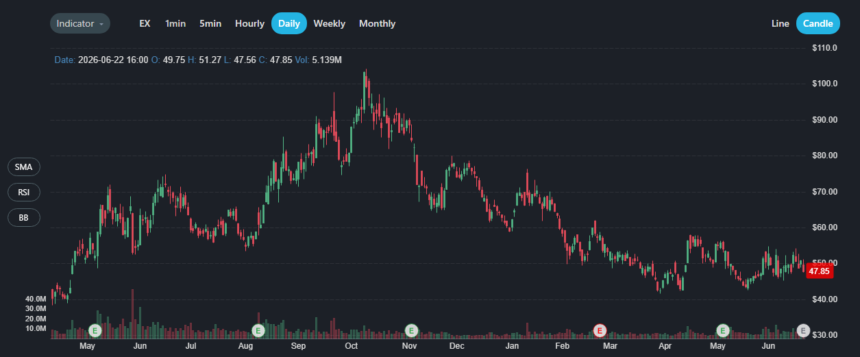
According to 16 Wall Street analysts covering TEM through TipRanks, the consensus is a “Moderate Buy” rating. The average 12-month price target sits around $65.93, with a high estimate of $100 and a low of $35. At recent trading prices around the mid-$50s, that average target represents meaningful upside even on the near-term view.
For the longer-term tempus ai stock forecast 2030, CoinCodex projects the stock could reach approximately $86 by the end of that year — about 65% above current prices. More aggressive technical models like gov.capital put the tempus ai stock forecast 2030 as high as $169. And the most bullish fundamental cases — which assume Tempus captures a dominant share of the precision medicine market and successfully expands into neurology and cardiology — suggest targets as high as $275.
On the cautious side, Traders Union’s statistical model points to an average of around $41 by 2030, based on current earnings trends continuing without major acceleration.
So depending on which model and which assumptions you use, the tempus ai stock forecast 2030 ranges from modest gains to several multiples of current value. That wide range is actually a healthy sign — it means analysts are taking the uncertainty seriously rather than manufacturing false confidence.
8 Factors That Will Define the Tempus AI Stock Forecast 2030
1. The Data Moat Gets Stronger Every Quarter
This is the part of the Tempus AI story that most casual observers miss. The company’s database now exceeds 350 petabytes of connected clinical and molecular data. And here’s the thing about data at that scale — the value compounds. Every new patient sample, every new clinical integration, every new AI model trained on that data makes the platform more useful. By 2030, if Tempus continues adding data at its current pace, the gap between them and any potential competitor becomes almost impossibly wide. When you’re thinking about the tempus ai stock forecast 2030, this compounding data moat is arguably the single most important variable.
2. The Path to Profitability Is Actually Visible
I’ve covered a lot of unprofitable tech companies that promised profitability “just around the corner” for years on end. Tempus feels different — and I say that with appropriate caution. The company swung from negative $7.4 million in adjusted EBITDA in 2025 to targeting $65 million in 2026. That’s a massive improvement in a single year. If the trajectory continues — and the revenue retention numbers of 126% suggest the installed customer base is expanding, not churning — then profitability by 2027 or 2028 is a realistic expectation, not a fantasy. That matters enormously for the tempus ai stock forecast 2030.
3. FDA Approvals Are Unlocking Pricing Power
Regulatory clearance is a big deal in diagnostics — it’s not just a checkbox, it’s a revenue driver. Tempus already received FDA approval for its xT CDx tumor test, which enables the company to charge higher prices and gain access to reimbursement from payers like Medicare. The pending xF liquid biopsy submission could be another catalyst. Every FDA approval Tempus earns between now and 2030 strengthens both the revenue line and the competitive moat. This regulatory dimension is often underappreciated in tempus ai stock forecast 2030 analyses.

4. The Data Licensing Business Could Be Worth More Than the Diagnostics Side
Here’s something that doesn’t get talked about enough. Tempus’s Data and Applications segment — the part that licenses de-identified clinical and molecular data to pharma companies and researchers — currently represents about 25% of revenue but has exceptional margin characteristics. With $1.1 billion in total remaining contract value and 126% net revenue retention, this business is essentially a recurring revenue engine that grows almost automatically. By 2030, if Tempus successfully monetizes this data library at scale, it could reshape the entire tempus ai stock forecast 2030 upside case.
5. Expansion Beyond Oncology Is a Genuine Growth Driver
Tempus started in oncology, and that remains the core. But the company is actively building capabilities in neuropsychiatry, cardiology, infectious disease, and radiology. Each new disease area is essentially a new market. The nP assay for pharmacogenomic testing in psychiatric conditions, for example, is a completely different customer base from oncology. If even two or three of these expansion areas develop into meaningful revenue contributors by 2030, the tempus ai stock forecast 2030 models need to be revised significantly upward.
6. Competition Is Real and Shouldn’t Be Dismissed
Look — I’m not going to pretend Tempus has no competitors. Companies like Foundation Medicine (owned by Roche), Guardant Health, and a growing number of AI-in-healthcare startups are all going after similar opportunities. The competitive landscape will be meaningfully more intense by 2030 than it is today. Tempus’s advantage is its data scale and its integration depth — with partnerships like NYU Langone Health and Northwestern Medicine — but that advantage has to be defended and extended year after year. This competitive risk is the honest counterweight in any realistic tempus ai stock forecast 2030 analysis.
7. Valuation Is Rich — And That Creates Risk
Let’s not dance around it. TEM is not a cheap stock by conventional metrics. The market is clearly pricing in a lot of future growth, which means any disappointing earnings report or guidance cut can result in painful drawdowns. The stock has already experienced significant volatility since its IPO. Investors who are not comfortable with 20-30% drops in a short period of time need to think carefully about position sizing when incorporating the tempus ai stock forecast 2030 into their portfolio decisions.
8. The Healthcare AI Tailwind Is Enormous
Step back from the company-specific details for a moment and look at the macro picture. Healthcare AI is one of the most significant technology trends of this decade. Governments, hospital systems, insurance companies, and pharmaceutical firms are all pouring resources into AI-driven clinical tools. Precision medicine — the idea that treatment should be tailored to each patient’s molecular and genetic profile — is moving from the cutting edge to the standard of care. Tempus is not fighting this trend. It is this trend. That macro alignment gives the tempus ai stock forecast 2030 a fundamental tailwind that’s hard to argue against.
The Honest Bull and Bear Cases
Bull Case: Tempus hits profitability in 2027. Data licensing revenues scale dramatically as pharma partnerships deepen. FDA approvals expand reimbursement access. The platform extends into cardiology and neuropsychiatry successfully. The tempus ai stock forecast 2030 approaches or exceeds the more aggressive analyst targets in the $150-$275 range.
Bear Case: Competition from well-funded rivals erodes market share. Reimbursement challenges slow diagnostic volume growth. The path to GAAP profitability extends further than expected. The valuation compresses. The tempus ai stock forecast 2030 ends up in the $40-$50 range — not a disaster, but not the story investors are currently paying for.
The realistic outcome? Probably somewhere in between. The tempus ai stock forecast 2030 is genuinely promising — but it requires execution. Management has to keep delivering on a very demanding growth timeline.
My Honest Take
I’ve been wrong on stocks before. I’ll be wrong on some in the future. But Tempus AI is one of the more compelling long-term investment stories I’ve come across in the healthcare technology space.
The combination of genuine data advantages, accelerating revenue growth, an improving profitability profile, and a massive addressable market makes the tempus ai stock forecast 2030 worth taking seriously. This is not a company built on hype. It’s built on petabytes of real clinical data, thousands of hospital integrations, and AI models trained on more cancer genomics than probably anyone else on earth.
That doesn’t make it risk-free. The valuation is demanding. The competition is real. And any long-term forecast in a sector this dynamic involves more uncertainty than any model will admit.
But if you’re looking at where healthcare is going over the next decade, and you want exposure to a company that appears to be building infrastructure for that future rather than just talking about it — the tempus ai stock forecast 2030 deserves a serious look.
Just make sure you size the position in a way that lets you sleep at night. High conviction and high volatility can coexist.