


Here is the honest truth about Archer Aviation stock. It is not for everyone. It is not a safe, boring investment that pays a steady dividend and lets you sleep at night. It is a high-stakes bet on a technology that could fundamentally change how people move through cities — or it could flame out like dozens of other ambitious companies that promised to reinvent transportation.
If you are trying to figure out where archer aviation stock prediction 2030 lands, you need to understand both sides of that equation clearly. Not just the exciting part. Both sides.
Let us get into it.
What Archer Actually Does
Archer Aviation is building electric air taxis. Specifically, they are developing an aircraft called Midnight — a five-seat electric vertical takeoff and landing (eVTOL) vehicle designed to carry four passengers and a pilot on short urban routes. Think Manhattan to JFK in 5 to 15 minutes instead of a 45-minute drive through gridlocked traffic. Think Los Angeles to LAX without sitting on the 405.
The idea is not new. Dozens of companies have been chasing this same vision for years. What sets Archer apart — and what makes the archer aviation stock prediction 2030 conversation worth having at all — is how far along they actually are compared to the competition.
Midnight is a real aircraft. It flies. Archer has completed piloted flight tests, passed three of the four FAA certification phases, and as of mid-2026, is working through Phase 4 — the final compliance testing stage before the FAA can issue a Type Certificate. Archer is the first eVTOL company in the world to close Phase 3 of that process.
That is not nothing.
Where Things Stand Right Now (Mid-2026)
The most recent update from Archer, reported in May 2026, showed the company closing Phase 3 of the FAA’s four-phase Type Certification process for Midnight. Phase 4 is where the aircraft has to prove compliance with FAA airworthiness requirements through formal, supervised testing. That is the final hurdle before U.S. commercial operations can begin.
Archer also ended Q1 2026 with approximately $1.8 billion in liquidity. That is genuinely important. In the world of pre-revenue aerospace startups, cash is survival. Having nearly two billion dollars on hand means Archer has runway — financial runway, not just aviation runway — to keep pushing through certification without the constant existential panic that kills smaller startups.
The company is targeting initial U.S. operations in 2026, in connection with the White House’s eVTOL Integration Pilot Program (eIPP) and in preparation for the 2028 Los Angeles Olympic Games. Those are hard deadlines with real eyes on them.
On top of all of that, Archer has partnerships with NVIDIA, Palantir, and Starlink as it builds out its AI stack for autonomous operations — a capability that matters enormously for the long-term scalability of air taxi networks.
The Order Book: $6 Billion Is Hard to Ignore
When you are looking at archer aviation stock prediction 2030, one number keeps coming up: $6 billion. That is the size of Archer’s order backlog.
United Airlines — a serious, hard-nosed airline with zero interest in burning money on science projects — has committed to purchasing up to 200 Midnight aircraft and has already paid a $10 million pre-delivery deposit. United has also formed a Joint eVTOL Advisory Committee with Archer to work on maintenance and operational planning. That is the kind of institutional engagement you do not do with a company you have written off.
Beyond United, Archer has orders from Southwest Airlines, Abu Dhabi Aviation, Ethiopian Airlines, Soracle, and Future Flight Global. International expansion is real and already in motion. Archer launched air taxi operations in Abu Dhabi as an early market — a smart move to get real-world operational data in a market with faster regulatory timelines than the U.S.
A $6 billion backlog does not guarantee anything. Orders can be cancelled. But it signals that serious buyers with significant money at stake believe Midnight will be a real product.
The Archer Aviation Stock Prediction 2030: What Analysts Are Saying
Here is where opinions diverge sharply, and you need to know that before doing anything with your money.
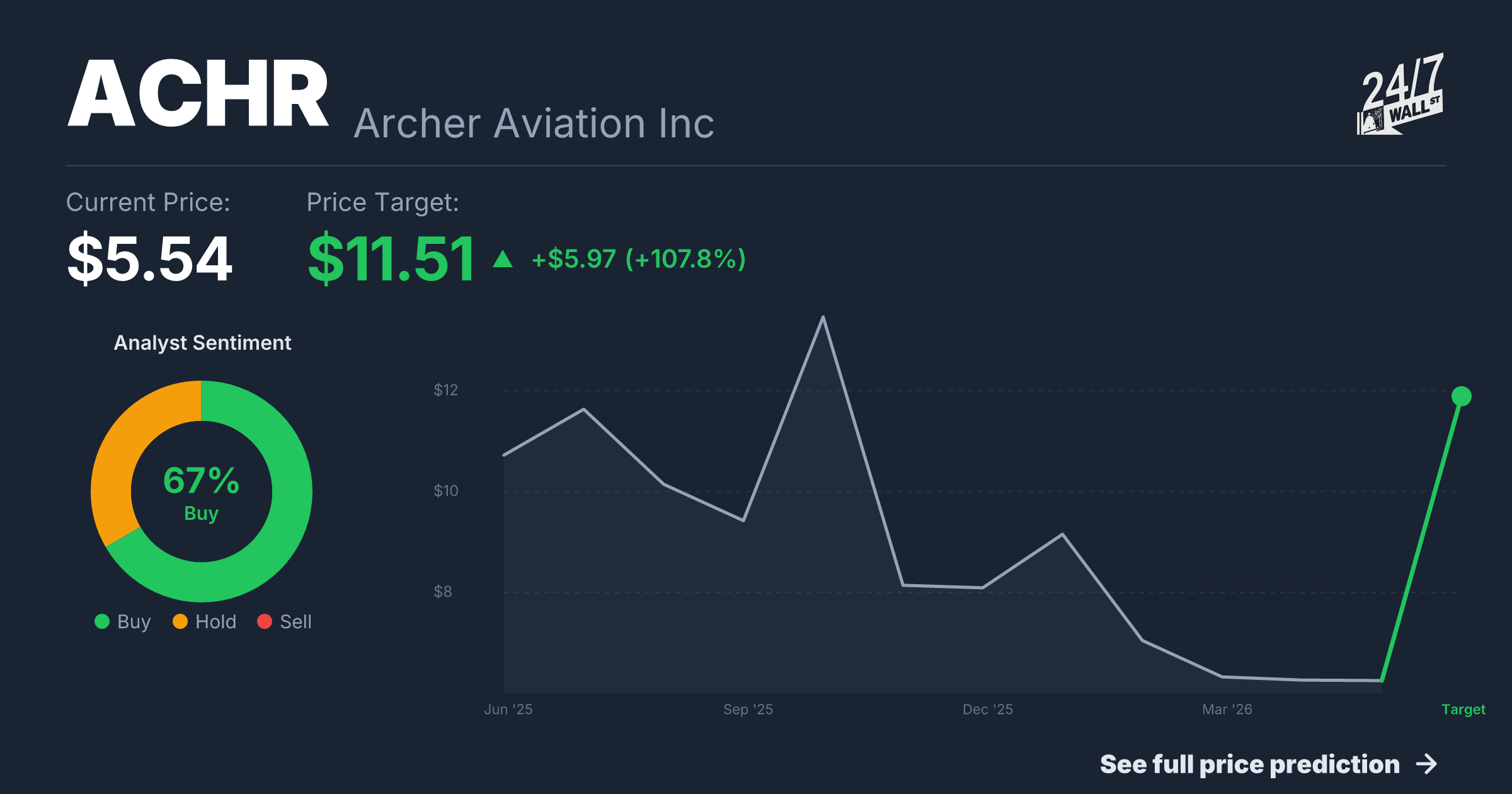
Bullish analysts point to the eVTOL market’s projected compound annual growth rate of around 25%, Archer’s first-mover position in FAA certification, the $6 billion order book, and the defense angle through their partnership with Anduril Industries. In the most optimistic scenarios, some price targets for archer aviation stock prediction 2030 go as high as $50 per share.
Bearish analysts point to the company’s continued net losses (an adjusted EBITDA loss of $172.5 million in Q1 2026) and the fact that Archer was burning cash at a fast pace. They also cite share dilution as a concern. Archer’s number of shares outstanding has grown by more than 170% since it went public, and there will likely be further dilution as the company continues to fund operations.
Conservative models for Archer aviation stock price forecast 2030 range from $10 to $15 per share, if Archer reaches commercial scale, but competition and capital requirements persist. The most bearish models — which factor in the possibility of continued delays or market adoption slower than projected — put 2030 targets closer to current levels or below.
The honest answer is that nobody truly knows where ACHR lands in 2030. Anyone who tells you otherwise with confidence is selling something.
The Real Risks Worth Understanding
The biggest risk for archer aviation stock prediction 2030 is not technical. Midnight flies. The technology works at the demonstration level. The risk is commercial execution.
Getting an eVTOL aircraft certified is one challenge. Building them at scale, maintaining them reliably, developing the vertiport infrastructure needed for passengers to board and disembark, training pilots at volume, winning over the general public who have never thought about getting into a small electric aircraft for a 10-minute commute — all of that is a different and arguably harder challenge.
The second big risk is competition. Joby Aviation is the other major player in U.S. eVTOL certification, and they are running a parallel race to get their own aircraft approved. If Joby beats Archer to market with a superior product or locks up key airline partnerships, the competitive landscape shifts quickly.
Share dilution is a real concern too. Every time Archer raises money — and it will need to raise more — existing shareholders get diluted. A company that has grown its share count by 171% since its IPO is a company that needs to be monitored on this front consistently.
Regulatory delay is always a risk with aviation. The FAA does not rush for anyone. If Phase 4 compliance testing throws up unexpected issues or new requirements, the 2026 commercial launch timeline slips. And slippage in this business is expensive.
The Bull Case for 2030
Now for the other side, because it is genuinely compelling.
If Archer hits its targets — FAA certification in 2026, commercial operations in U.S. cities, scaling production toward hundreds of aircraft annually — the revenue trajectory is dramatic. Analysts who model successful commercialization project revenue surging from essentially zero today to hundreds of millions of dollars by 2028 and potentially into the billions by 2030.
The defense angle adds a dimension most investors initially overlook. Archer’s partnership with Anduril Industries opens the door to government contracts for autonomous vertical lift — logistics, surveillance, search and rescue — that could generate meaningful revenue independent of the commercial air taxi rollout. The U.S. military has shown real interest in eVTOL technology, and Archer’s positioning here gives it a diversified revenue stream that pure air taxi companies do not have.
The LA28 Olympics connection is also bigger than it sounds. If Archer is running air taxi operations during the 2028 Los Angeles Olympic Games — one of the most-watched events on earth — the brand exposure and proof-of-concept visibility is enormous. It is the kind of showcase that validates a technology in front of a global audience.
Where Does Archer Aviation Stock Go by 2030?
Putting it plainly: archer aviation stock prediction 2030 depends almost entirely on execution.
If Archer gets FAA certification, launches commercial operations, scales production toward 50-plus aircraft per year, and captures even a modest slice of the projected eVTOL market, the stock is likely worth significantly more than its current price. Bullish cases that reach $30 to $50 per share by 2030 are not absurd — they require success, but they are mathematically possible given the market size.
If commercial operations are delayed beyond 2027, if competition intensifies in ways that compress margins, if dilution continues at the current pace, or if the public simply does not adopt air taxis as quickly as models assume — the stock could stay flat or worse.
The middle scenario — partial success, slower-than-expected scaling, but survival and growing revenue — probably lands archer aviation stock prediction 2030 somewhere in the $10 to $20 range.
Final Verdict
Archer Aviation is the most technically advanced eVTOL company in the U.S. right now in terms of FAA certification progress. The $6 billion order book is real. The partnerships are serious. The technology flies.
Whether that translates into a stock that returns serious money by 2030 depends on execution, regulation, competition, and a market that has to actually get comfortable with the idea of urban air taxis.
For aggressive, patient investors who understand they are buying a long-term story with genuine near-term risks — archer aviation stock prediction 2030 represents one of the more interesting high-risk, high-reward setups in the growth stock universe right now.
For conservative investors who need predictable outcomes — this is not your stock.
Know which one you are before you decide.