
I’ll be straight with you from the start — ACM Research is not a company most people talk about at dinner tables or on mainstream financial TV. It doesn’t have the brand recognition of NVIDIA or the Twitter following of Tesla. It’s a mid-cap semiconductor equipment maker headquartered in Fremont, California, with most of its actual business happening inside China.
- What ACM Research Actually Does
- The Numbers That Actually Impressed Me
- What Analysts Are Saying About the ACMR Stock Forecast 2030
- 7 Things That Will Actually Decide the ACMR Stock Forecast 2030
- 1. China Concentration Is the Central Risk — Full Stop
- 2. International Expansion Is the Critical Counterweight
- 3. Advanced Packaging Is a Genuine Growth Engine
- 4. The Shanghai Subsidiary Dual-Listing Is a Wild Card
- 5. Margins Are Under Pressure and Need to Stabilize
- 6. The AI and HBM Tailwind Is Real
- 7. The Stock Has Already Been Volatile — And Will Continue to Be
- The Honest Bull and Bear Cases
- My Honest Take
And yet, when I started digging into the acmr stock forecast 2030, I kept coming back to the same uncomfortable thought: this might be one of the more genuinely interesting growth stories in the semiconductor equipment space right now — if you can stomach the risks that come attached to it.
Let me tell you what I found.
What ACM Research Actually Does
Before you can form any serious opinion on the acmr stock forecast 2030, you need to understand what this company actually builds and sells.
ACM Research, Inc. trades on NASDAQ under the ticker ACMR. Founded in 1998 by Dr. David Wang and Hui Wang, the company makes wafer processing equipment — specifically, tools used in semiconductor manufacturing to clean wafers, plate metal layers, and handle advanced packaging processes. Its products include wet cleaning equipment, electrochemical plating (ECP) tools, furnace systems, PECVD tools, and a growing lineup of advanced packaging solutions.
If those terms sound technical, here’s the simple version: semiconductor chips require incredibly precise manufacturing. Before and after each step of that process, the wafers have to be cleaned and processed with extreme care. ACM Research makes the machines that do that job. Its core technology — SAPS (Space Alternated Phase Shift) and TEBO (Timely Energized Bubble Oscillation) — are proprietary cleaning methods the company developed in-house.
The majority of ACMR’s business runs through its principal subsidiary, ACM Research (Shanghai), Inc. — which is separately listed on China’s STAR Market. That dual-listing structure, and the heavy China concentration, is both the source of ACM’s remarkable growth and the biggest risk in any acmr stock forecast 2030 discussion.
The Numbers That Actually Impressed Me
Here’s where ACMR separates itself from a lot of companies in the semiconductor equipment space.
In 2025, ACM Research updated its full-year revenue outlook to $885–$900 million — a meaningful jump from the prior year’s $755–$770 million range. For 2026, the company guided for revenue between $1.08 billion and $1.175 billion. That’s a $1 billion business growing at 20–30% per year. That’s not a small company anymore.
Q1 2026 confirmed the trajectory. Revenue came in at $231 million — up 34% year-over-year. Shipments were even stronger at $241 million, up 54%. CEO Dr. David Wang specifically pointed to strong performance in ECP and advanced packaging as the primary drivers. The company reaffirmed its full-year 2026 guidance without flinching.
Analysts who follow ACMR closely have noted that the company’s narrative projects roughly $1.4 billion in revenue by 2028 — which would require sustaining around 19% annual growth from here. Looking at the trajectory, that’s not an unreasonable target, even if it demands consistent execution.
When you’re building a view on the acmr stock forecast 2030, these revenue numbers are not the problem. The problem is everything that sits around them.
What Analysts Are Saying About the ACMR Stock Forecast 2030
This is where the picture gets genuinely complicated.
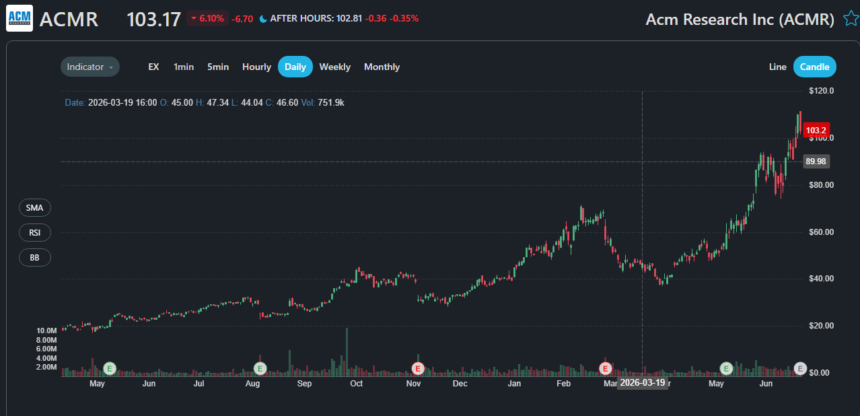
Near-term, the analyst consensus on ACMR is a Buy, with an average 12-month price target around $43–$45 from the analysts actively covering it. Roth Capital raised its target to $125 in June 2026. Goldman Sachs issued a Buy in May 2026. J.P. Morgan has also been bullish. These are not small banks making casual calls — major institutions are paying attention to ACMR.
For the longer-term acmr stock forecast 2030, the range of predictions is almost comically wide — which itself tells you something important. StockScan puts the acmr stock forecast 2030 average at around $68, with a high of $93 and a low of $43. Bitget’s aggregation of Wall Street and investment bank forecasts places the acmr stock forecast 2030 range between $183 and $917. That upper end is extraordinary — and reflects what happens to the math if ACM Research sustains above-average growth and gets a multiple expansion.
On the conservative end, some technical models project the stock much lower, in the $13–$27 range by 2030, based purely on momentum and near-term price pressure. These models don’t account for business fundamentals — they just follow price trends.
The truth of where the acmr stock forecast 2030 lands will depend almost entirely on two things: whether ACM can successfully diversify away from China, and whether US export controls escalate or stabilize.
7 Things That Will Actually Decide the ACMR Stock Forecast 2030
1. China Concentration Is the Central Risk — Full Stop
I’m putting this first because it deserves to be first. ACM Research generates a substantial majority of its revenue from Chinese semiconductor manufacturers. That’s been an enormous growth driver — China has been investing aggressively in domestic chip manufacturing, and ACM’s equipment has been right in the middle of that buildout.
But this concentration creates a vulnerability that investors in ACMR absolutely cannot ignore. US export controls on semiconductor equipment sold to China have already been tightened multiple times. Every time Washington moves on this front, ACMR stock reacts sharply. The acmr stock forecast 2030 lives and dies, to a significant degree, on how this geopolitical dynamic evolves over the next four years.
If export controls tighten dramatically — or if China-US trade relations deteriorate significantly — ACM’s revenue base could be disrupted in ways that no amount of good technology can fix quickly.
2. International Expansion Is the Critical Counterweight
To ACM’s credit, management is not sitting back and ignoring this risk. The company has explicitly named international expansion as a strategic priority, with specific focus on Southeast Asia and other markets outside China. They’re expanding their global sales footprint and actively pursuing overseas customers.
Whether they can execute this pivot meaningfully before 2030 is one of the defining questions for the acmr stock forecast 2030. Semiconductor equipment sales cycles are long. Building relationships with chipmakers in South Korea, Taiwan, Japan, or Europe takes time and proven technology. ACM has the technology — the question is speed of adoption.
3. Advanced Packaging Is a Genuine Growth Engine
Here’s something that doesn’t get enough attention in ACMR coverage. The advanced packaging segment — which includes ECP tools for high-performance chip interconnects and panel-level packaging — is growing faster than the core cleaning business. Q1 2026’s 54% shipment growth was driven heavily by ECP and advanced packaging adoption.
This matters because advanced packaging is where the semiconductor industry is heading as traditional Moore’s Law scaling becomes harder and more expensive. Chipmakers are increasingly stacking chips together and connecting them with advanced packaging techniques — and that creates demand for exactly the kind of tools ACM makes. If this segment scales significantly by 2030, it reshapes the acmr stock forecast 2030 upside case materially.
4. The Shanghai Subsidiary Dual-Listing Is a Wild Card
ACM Research (Shanghai) trades separately on China’s STAR Market. This dual structure creates some unusual dynamics. On one hand, it gives the Chinese subsidiary access to local capital markets and regulatory frameworks. On the other hand, it means ACMR investors in the US are exposed to currency risk, regulatory decisions in two different jurisdictions, and a governance structure that some institutional investors view with skepticism.
Insiders at ACM have net sold shares over the past year — not catastrophic, but worth noting. When you’re evaluating the acmr stock forecast 2030, the Shanghai listing structure is a factor that deserves more scrutiny than most retail investors give it.
5. Margins Are Under Pressure and Need to Stabilize
Revenue growth has been impressive — no question. But margin compression has been a theme in recent quarters. Gross margins have been squeezed by a mix of product shifts, rising R&D investment, and competitive pricing dynamics in the Chinese market. The company itself has guided for a 42–48% gross margin range in 2026, with R&D spending at 14–19% of revenue.
For the acmr stock forecast 2030 to play out bullishly, margins need to stabilize and ideally expand as the product mix shifts toward higher-value tools and international customers — who typically pay better margins than domestic Chinese buyers. If margins keep compressing even as revenue grows, the earnings story doesn’t improve as fast as the revenue line suggests.
6. The AI and HBM Tailwind Is Real
Semiconductor equipment is not immune to macro trends — and right now, the macro trend in semiconductors is AI-driven demand. High-bandwidth memory, advanced logic chips, and complex packaging for AI accelerators all require exactly the kind of wet processing and plating tools that ACM makes. The company’s ECP tools, in particular, are relevant for the kind of advanced interconnects used in high-performance AI chip stacks.
This AI tailwind is not guaranteed to benefit ACMR directly — it depends on which fabs are buying what tools. But directionally, the semiconductor equipment market is expanding because of AI investment, and ACM is positioned in the right technical segments to capture some of that growth. It’s an underappreciated element of the acmr stock forecast 2030 bull case.
7. The Stock Has Already Been Volatile — And Will Continue to Be
Let’s be real about what owning ACMR actually feels like. This is a stock with a beta of 1.7 — meaning it moves roughly 70% more than the broader market on average. When semiconductor sector sentiment turns negative, ACMR tends to fall hard. When it turns positive, ACMR tends to rally sharply. The stock has already made massive moves in both directions over its history.
The acmr stock forecast 2030 is not a comfortable, steady-climb story. It’s a high-volatility, high-conviction play that will test your patience multiple times before 2030 arrives. If you can’t hold through a 30-40% drawdown without panicking, this might not be the right position for you regardless of how attractive the long-term thesis looks.
The Honest Bull and Bear Cases
Bull Case: Export controls stay manageable. International expansion gains real traction in Southeast Asia and beyond. Advanced packaging becomes a major revenue contributor. AI-driven semiconductor capex sustains strong equipment demand through 2028. ACM hits or exceeds its $1.4 billion revenue target. The acmr stock forecast 2030 ends up well above $100 — possibly significantly higher if the multiple expands along with earnings.
Bear Case: Washington tightens export controls sharply. China revenue slows materially. International expansion takes much longer than expected. Margins keep compressing. Revenue growth slows to single digits by 2028. The acmr stock forecast 2030 ends up in the $20–$40 range — a significant disappointment from current levels.
The most likely outcome sits somewhere between these extremes. The acmr stock forecast 2030 has real upside potential — but it is genuinely geopolitically exposed in ways that most other semiconductor equipment companies are not.
My Honest Take
I find ACMR genuinely interesting and genuinely nerve-wracking at the same time — which is usually a sign that the market is correctly pricing in real uncertainty.
The company has built real technology. The revenue growth has been exceptional. The addressable market in semiconductor equipment, driven by AI investment and domestic Chinese chip ambitions, remains large. And the pivot toward international customers and advanced packaging is the right strategic move.
But you have to go into this with clear eyes about the China risk. This is not a company where you can just look at the revenue growth chart and feel comfortable. The geopolitical context around ACMR is as important as the income statement — and that context can change fast.
The acmr stock forecast 2030 is one of the more genuinely uncertain long-term calls I’ve looked at recently. There’s a version of this story where patient investors do very well. There’s also a version where export control escalation permanently impairs the business model and the stock goes nowhere for years.
If you’re going in, know which risks you’re accepting. Size accordingly. And watch the geopolitical headlines as carefully as you watch the earnings releases.
That’s the honest version of the acmr stock forecast 2030.