
If you hold SOXL or you have been watching it from the sidelines, the phrase “reverse split” probably made you stop and pay attention. It should. Reverse splits in leveraged ETFs work a little differently than in regular stocks, and if you do not understand what is actually happening, you can make the wrong call at exactly the wrong moment. This article breaks down the SOXL reverse split from top to bottom — what it is, why it happens, what the history looks like, and what it actually means for your money.
- What Is SOXL, and Why Does Any of This Matter?
- The Daily Reset Problem That Creates Reverse Splits
- What Is a Reverse Split, and What Does It Do to Your Shares?
- SOXL Reverse Split History: What Actually Happened
- Why Investors Panic Over the Words “Reverse Split”
- What Smart Traders Think About Before a Reverse Split
- The Risks That Come With SOXL — Reverse Split or Not
- The Bottom Line on the SOXL Reverse Split
What Is SOXL, and Why Does Any of This Matter?
Before we get into the mechanics of the SOXL reverse split, it is worth spending a moment on what SOXL actually is, because that context changes everything.
SOXL is the Direxion Daily Semiconductor Bull 3X Shares ETF. It was launched on March 11, 2010 by Direxion and is managed by Rafferty Asset Management. The fund’s job is straightforward: deliver 300% of the daily performance of the NYSE Semiconductor Index, a basket of the 30 largest US-listed semiconductor companies. As of early 2026, the top holdings include Nvidia at 8.41%, Broadcom at 8.28%, Micron at 7.00%, Advanced Micro Devices at 6.48%, and Applied Materials at 5.85%.
That 3x daily leverage is the key word. When semiconductor stocks go up 2% on a given day, SOXL is engineered to rise roughly 6%. When they fall 2%, it drops roughly 6%. This makes it one of the most actively traded ETFs on the market — its dollar trading volume regularly beats even the most popular traditional semiconductor ETF, the VanEck Semiconductor ETF (SMH).
The leverage is also why the SOXL reverse split happens in the first place. But to understand that, you need to understand something called volatility decay.
The Daily Reset Problem That Creates Reverse Splits
Here is something most retail traders learn the hard way.
SOXL resets its leverage at the close of every single trading day. That sounds simple, but it creates a mathematical trap. Here is a basic example: if the underlying semiconductor index falls 10% one day and then rises 9.09% the next day, it is back to flat. But SOXL, after delivering 3x each of those days, is down roughly 5.5%. Repeat that choppy pattern across weeks and months, and the fund slowly bleeds value even if the underlying index is essentially unchanged.
This effect — often called volatility decay or beta slippage — is the core reason SOXL is described by Direxion itself as a short-term trading tool, not a buy-and-hold investment. When markets are trending strongly in one direction, SOXL can produce extraordinary returns. When they chop sideways, it erodes. And when they crash, the losses are brutal.
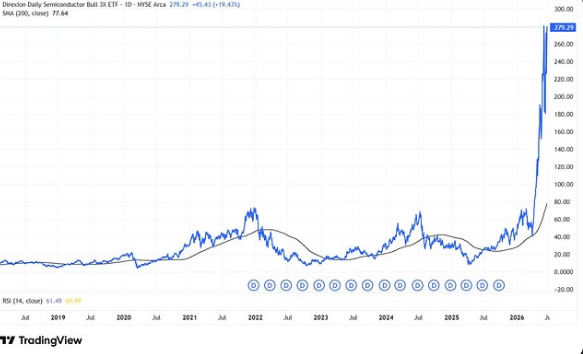
In 2022, the semiconductor index fell around 35%. SOXL fell roughly 90% that same year. That is not a typo. A 90% loss requires a 900% gain just to get back to break even. The fund did eventually recover — the AI-driven semiconductor rally of 2025 to 2026 pulled it back — but SOXL holders who bought at the 2021 top waited years for the math to catch up.
This volatility decay and the resulting drop in share price is what eventually triggers a SOXL reverse split.
What Is a Reverse Split, and What Does It Do to Your Shares?
A reverse split is when a fund or company reduces the number of shares in circulation while proportionally increasing the price per share, so that each investor’s total dollar value stays exactly the same.
Here is a simple example. If you hold 100 shares of a fund trading at $5, and the fund executes a 1-for-10 reverse split, you end up with 10 shares — but each one is now worth $50. Your total investment is still $500. Nothing has changed in terms of the actual value you hold.
So why do it at all? Two main reasons.
First, when a share price falls to very low levels — sometimes under $1 — it can be removed from major exchanges, lose trading privileges, or become unattractive to institutional investors who have minimum price requirements. A reverse split brings the price back up to a respectable level without changing the underlying economics.
Second, extremely low-priced shares with massive trading volumes can create operational and regulatory issues. Funds like SOXL trade tens of millions of shares per day. When the price gets very low, the sheer volume of shares becomes unwieldy.
SOXL Reverse Split History: What Actually Happened
The SOXL reverse split history is short but important to understand in context.
SOXL’s most recent reverse split on the bull side was on March 2, 2021. That split had a ratio of 1-for-15 — meaning that for every 15 shares you held before the split, you woke up the next morning holding 1 share, worth 15 times the original per-share price. Your total holding value did not change by a single dollar.
It is worth noting that SOXL had previously done forward splits — when the price gets too high, Direxion splits the shares to bring the price down and improve accessibility for retail traders. The first forward split happened on May 20, 2015 on a 4-for-1 basis. The 15-for-1 forward split in 2021 came when SOXL’s price had climbed high enough to make it less accessible.
What this tells you is that SOXL reverse splits happen when the price has fallen too low, while forward splits happen when the price has risen too high. Direxion uses both tools to keep the share price in a range that works for regular investors and the market structure of the exchange.
Importantly, as of 2026, SOXL itself has not announced a new reverse split. Direxion did announce reverse splits in early 2026, but those applied to other funds — specifically JDST, SOXS (the bear semiconductor ETF), DUST, and HIBS. In February 2026, Direxion announced a reverse split for SOXS effective March 4, 2026, with a 1-for-20 ratio. A second SOXS reverse split was announced in June 2026.
SOXS keeps getting reverse splits because it is the inverse — it goes down when semiconductors go up, and semiconductors have been on a massive bull run. SOXL, by contrast, has been performing strongly in the AI era, so its price has not fallen to the point where Direxion needs to do a SOXL reverse split.

Why Investors Panic Over the Words “Reverse Split”
Here is the honest answer: most people associate the phrase “reverse split” with a company in trouble. In the regular stock world, that association is not entirely wrong. A company that reverse-splits its stock is often doing so because the share price has crashed, and it needs to avoid being delisted. That can signal fundamental problems with the business.
With a leveraged ETF like SOXL, the story is completely different. The share price falling has nothing to do with the fund being “in trouble.” It has to do entirely with the mathematical effects of daily leverage during a period of market decline. Direxion is not going bankrupt. The fund is not losing assets in some mysterious way. The semiconductor companies it tracks still exist and still have value. The SOXL reverse split is simply a housekeeping action — a way to keep the fund’s share price at a level that works logistically.
The total value of your investment does not change on the day of a reverse split. Period. If you held $10,000 worth of SOXL before a 1-for-10 reverse split, you still hold $10,000 worth of SOXL the next morning. You just hold fewer shares, each worth more.
What Smart Traders Think About Before a Reverse Split
While the reverse split itself does not change your investment value, it does tell you something important: the fund’s share price has dropped significantly from where it was. And for a 3x leveraged ETF like SOXL, a big price drop means the underlying semiconductor market has gone through a serious downturn.
That is the real information to pay attention to. Not the mechanics of the split itself, but the market conditions that made the split necessary.
Some traders use periods around a SOXL reverse split as potential entry points. Their logic: if the semiconductor sector has fallen far enough to drag SOXL’s price to single digits, and if they believe the sector will recover, then buying in at depressed levels — before or after a reverse split — can set up for big gains when the trend reverses. This is exactly what happened to people who bought SOXL near its lows in late 2022 and held through the 2025 to 2026 AI semiconductor rally, when SOXL delivered triple-digit and even quadruple-digit percentage gains.
But this strategy requires a strong stomach and a clear view of the semiconductor cycle. Anyone who misjudges the timing can find themselves holding an ETF that bleeds further, because SOXL’s daily leverage cuts both ways.
The Risks That Come With SOXL — Reverse Split or Not
Whether or not a SOXL reverse split is on the horizon, there are permanent risks built into this fund that every holder needs to keep in their mind at all times.
Volatility decay is always working against you during choppy markets. The 0.95% annual expense ratio is not huge, but it adds up over time. SOXL is non-diversified, meaning it is fully concentrated in one sector. And as Direxion is quite clear in its own materials, this fund seeks daily investment goals — it should not be expected to track the underlying index over periods longer than a single trading day.
In 2022, SOXL fell 90% while the underlying semiconductor index fell just 35%. That gap is the cost of leverage in a declining market. In the 2025 to 2026 AI rally, SOXL rose over 790% in a 12-month period while the index returned far less. That gap is the reward of leverage in a rising market. The structure cuts both ways with equal force.
The Bottom Line on the SOXL Reverse Split
The SOXL reverse split is not the scary event that the words might suggest to someone used to thinking about regular stocks. It is a mechanical adjustment that keeps the fund operating smoothly. Your investment value does not change when one happens. What changes is the number of shares you hold and the price per share.
What the SOXL reverse split does tell you, when it occurs, is that the semiconductor sector has gone through a serious downturn and that SOXL’s daily leverage has amplified that downturn significantly. Understanding that context — and knowing how daily reset, volatility decay, and compounding all interact — is what separates traders who use SOXL intelligently from those who get caught off guard.
SOXL is one of the most powerful and most dangerous tools available to retail traders. Used correctly and with eyes wide open, it can produce returns that are almost hard to believe. Used carelessly, it can destroy capital faster than almost anything else in the market.
The reverse split is not the story. The story is always the semiconductor cycle — and where you think it is going next.