

If you’ve spent any real time trading on PredictIt, you’ve probably run into a moment where you stared at a share price and thought, “okay, but what does this actually mean in dollars once fees get involved?” That’s exactly the gap a predictit calculator fills. It’s not some flashy tool with a ton of bells and whistles. It’s a simple, practical way to turn raw share prices into numbers you can actually plan around, because PredictIt’s fee structure isn’t as straightforward as it looks at first glance.
- Why PredictIt’s Pricing Isn’t as Simple as It Looks
- What a PredictIt Calculator Actually Does
- Converting PredictIt Prices Into Odds
- Comparing PredictIt to Other Prediction Markets
- Using a PredictIt Calculator for Tax Reporting
- Arbitrage and Multi-Market Strategies
- Why the Fee Structure Trips People Up
- Choosing a Good PredictIt Calculator
- A Quick Real-World Walkthrough
- Final Thoughts
In this article, I want to walk through what this kind of tool actually does, why the platform’s fees make one necessary, how the math works underneath the hood, and how traders use these tools day to day to avoid getting blindsided by numbers that look better on paper than they turn out in real life.
Why PredictIt’s Pricing Isn’t as Simple as It Looks
PredictIt runs on a pretty intuitive idea. Every share trades somewhere between one cent and ninety-nine cents, and that price is basically the market’s best guess at the probability of something happening. A share sitting at sixty cents is telling you the crowd thinks there’s roughly a sixty percent chance that event plays out. If it happens, your yes shares pay out a full dollar each. If it doesn’t, they’re worth nothing.
Sounds clean, right? Here’s where it gets messy. PredictIt takes a ten percent cut of your profits, and on top of that, there’s a five percent fee whenever you withdraw money from the platform. Neither of these fees show up in the share price itself. You have to calculate them separately, and that’s exactly where a predictit calculator earns its keep. Without one, you’re doing this math by hand every single time you want to know your real return, and that gets old fast, especially if you’re juggling multiple positions across different markets.
What a PredictIt Calculator Actually Does
At its core, a predictit calculator takes your entry price, your number of shares, and runs the numbers through PredictIt’s fee structure to spit out your actual net profit. Instead of eyeballing a rough estimate, you get a precise figure that already accounts for the ten percent profit fee.
Some versions of a predictit calculator go a step further and also factor in the five percent withdrawal fee, since that’s technically a separate cost that hits you later when you actually try to pull your money out. This matters more than people realize. A trade that looks solidly profitable before fees can shrink meaningfully once both charges are applied, and seeing that number clearly before you commit real money is the whole point of using a calculator in the first place.
Here’s a simple example to show why this matters. Say you buy a share at forty cents, and the event resolves in your favor, meaning that share pays out a full dollar. Your gross profit looks like sixty cents. But PredictIt takes ten percent of that profit, which is six cents, leaving you with fifty-four cents net. Multiply that across a hundred shares and the difference between the gross number and the fee-adjusted number becomes six dollars, which isn’t nothing when you’re trying to plan your bankroll accurately.
Converting PredictIt Prices Into Odds
Another common use for a predictit calculator is converting share prices into more familiar betting odds formats, like American odds or decimal odds. This is especially handy if you’re used to sportsbooks and want to compare a PredictIt market against something like a traditional betting line.
The conversion itself is fairly straightforward mathematically. You divide one dollar by the share price to get decimal odds. A forty cent contract works out to 2.50 in decimal terms, which converts to plus one-fifty in American odds. But once PredictIt’s fee gets layered on top, that same forty cent contract effectively behaves more like plus one-thirty-five once fees eat into your realistic payout. A good predictit calculator handles this conversion automatically, so you’re not stuck doing arithmetic in your head while trying to decide whether a trade is actually worth making.
Comparing PredictIt to Other Prediction Markets
A lot of traders don’t just use PredictIt in isolation. They’re also active on platforms like Kalshi or Polymarket, and comparing fee structures across all three is a common reason people reach for a predictit calculator in the first place. Polymarket generally doesn’t charge explicit trading fees, which makes its numbers simpler to work with. Kalshi uses a small parabolic fee formula that scales based on price and contract volume, but it’s usually much lower than what PredictIt charges.
PredictIt, by comparison, tends to be the most expensive of the three once you stack the ten percent profit fee with the five percent withdrawal fee. This doesn’t mean PredictIt is a bad platform, but it does mean that traders who move between multiple prediction markets need a reliable way to see effective odds side by side rather than comparing raw prices, which can be misleading. This is exactly the kind of comparison a solid predictit calculator, especially one built to handle multi-platform inputs, is designed to solve.
Using a PredictIt Calculator for Tax Reporting
Here’s something a lot of casual traders overlook until tax season rolls around. PredictIt itself has stated that for IRS reporting purposes, net profit gets calculated as gross profits minus losses minus trading fees minus withdrawal fees. That five percent withdrawal fee gets included in the yearly calculation whether or not you’ve actually withdrawn the money yet, which can catch people off guard.
A calculator that accounts for both fees isn’t just useful for deciding whether to enter a trade. It also helps you keep a running, accurate picture of your actual net position throughout the year, so when tax time comes, you’re not scrambling to reconstruct months of trading activity from memory or scattered spreadsheets.
Arbitrage and Multi-Market Strategies
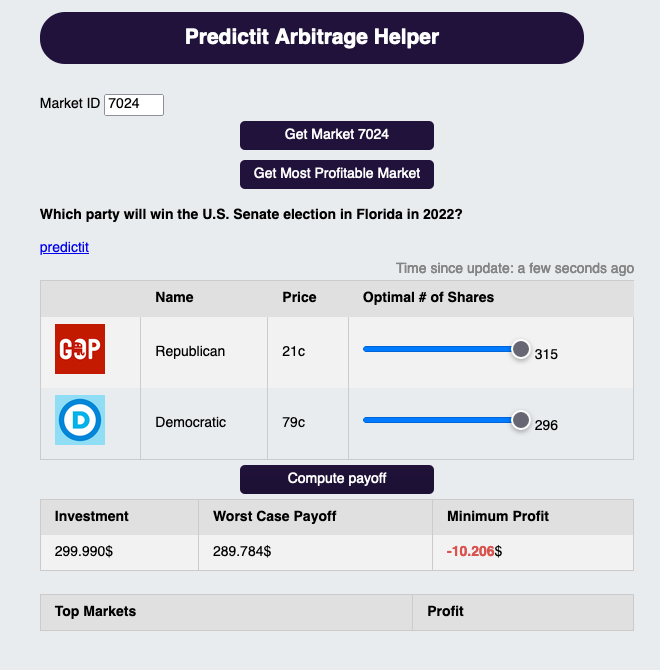
Some traders use a predictit calculator for more advanced purposes, like spotting arbitrage opportunities. The basic idea behind arbitrage on prediction markets is finding situations where buying opposing positions across different markets, or even within the same market, guarantees a profit regardless of the outcome, once you’ve accounted for fees properly.
Because PredictIt’s fee only applies to winning positions and not losing ones, this creates a slightly asymmetric situation compared to platforms with flat per-trade fees. A tool built with arbitrage in mind will typically let you plug in multiple contract prices and figure out the exact number of shares needed to lock in a guaranteed return, factoring in that ten percent hit on the winning side. This kind of calculator takes what would otherwise be a fairly involved spreadsheet exercise and turns it into something you can check in seconds before committing capital.
Why the Fee Structure Trips People Up
It’s worth pausing on why PredictIt’s fees feel sneaky to a lot of newer traders. The ten percent profit fee only shows up on winning trades, so it’s easy to underestimate its impact if you’re mentally calculating expected returns using round numbers instead of running the actual math. A trade that looks like it has a comfortable edge on paper can look a lot less appealing once you actually run it through a predictit calculator and see the fee-adjusted numbers.
This becomes especially noticeable on high-probability contracts. If you’re buying a share at ninety cents because you’re confident the event will happen, your potential profit is already small to begin with, just ten cents per share. Take ten percent off that thin margin and your effective return drops even further, which is exactly the kind of scenario where relying on this kind of calculator before placing the trade saves you from a nasty surprise later.
Choosing a Good PredictIt Calculator
Not every calculator built for PredictIt traders works the same way. Some are extremely basic, handling only the ten percent profit fee and nothing else. Others are more comprehensive, factoring in the withdrawal fee, letting you compare against Kalshi and Polymarket simultaneously, and even helping with odds conversion and expected value calculations.
If you’re trading occasionally, a simple predictit calculator that handles the core profit fee math is probably enough. But if you’re trading regularly across multiple prediction markets, it’s worth looking for one that bundles in fee comparisons, odds conversion, and maybe even basic arbitrage detection, since switching between five different tools just to evaluate one trade gets tedious fast.
A Quick Real-World Walkthrough
Let’s actually run through a realistic scenario to see how a predictit calculator changes the picture. Imagine you’re eyeing a market on a Senate race, and the yes share for your preferred outcome is sitting at seventy cents. On the surface, that looks like a thirty cent profit per share if you’re right, since the payout on a winning share is a flat dollar.
Plug that into a predictit calculator, though, and the ten percent profit fee immediately shaves three cents off that thirty cent gain, dropping your net profit to twenty-seven cents per share. Now say you’re planning to eventually withdraw those winnings. The five percent withdrawal fee applies on top, which trims your final take-home even further once the money actually leaves the platform. If you bought two hundred shares, the difference between the naive thirty cent estimate and the real fee-adjusted number ends up being several dollars, and that gap only grows as your position size increases.
This is really the whole argument for using a predictit calculator instead of doing quick mental math. It’s not that the arithmetic is impossible to do by hand. It’s that doing it accurately, every single time, across dozens of trades, is tedious and error-prone, and small miscalculations compound over a full trading year. A calculator removes that friction entirely and gives you a number you can actually trust.
Final Thoughts
A predictit calculator isn’t a complicated tool, and it doesn’t need to be. Its entire value comes from doing something simple extremely well: turning PredictIt’s somewhat unusual fee structure into a clear, honest number you can actually trust before you put money on the line. Between the ten percent profit fee and the five percent withdrawal charge, the gap between what a trade looks like on the surface and what it actually pays out can be bigger than most people expect.
Whether you’re a casual trader who checks in during big elections or someone trading PredictIt markets regularly throughout the year, running your numbers through a predictit calculator before you commit is one of those small habits that pays for itself. It won’t make you a better predictor of political outcomes, but it will make sure the numbers you’re basing your decisions on actually reflect reality once every fee has been accounted for.