

Kvadgen has been showing up a lot lately across crypto news sites and YouTube. The pitch is big: an AI-powered commerce platform, a token called KDN, and promises of major exchange listings in 2026.
- What Is Kvadgen?
- The KDN Token
- The Exchange Listing Claims
- Where the Marketing Comes From
- Multiple Domains, One Project?
- What’s Actually Verifiable Right Now
- Common Red Flags in Presale Tokens
- Questions Worth Asking Before Buying KDN
- Is Kvadgen a Good Investment?
- Frequently Asked Questions
- Kvad gen in the Bigger Picture
- The Bottom Line
If you’ve come across Kvadgen and you’re wondering whether it’s worth your attention, this article breaks down what the project actually claims, how its presale works, and what’s worth double-checking before you commit any money.
What Is Kvadgen?
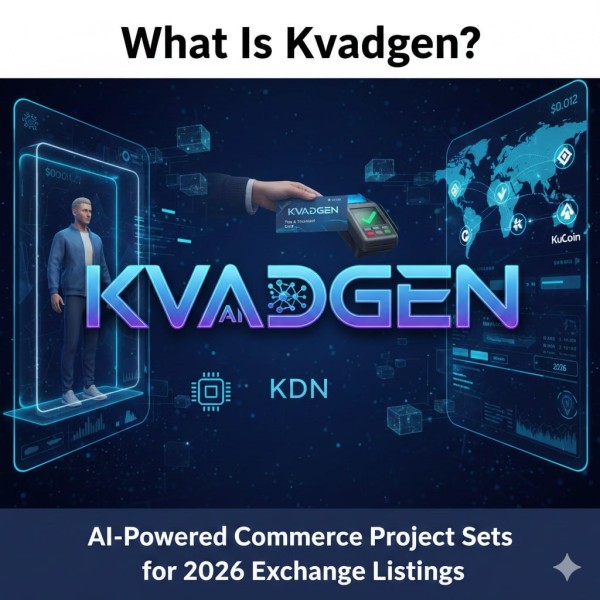
Kvadgen describes itself as a blockchain-based e-commerce platform. The core idea is to combine artificial intelligence with decentralized payments to make online shopping faster, cheaper, and more transparent.
According to Kvadgen’s own materials, the platform includes a payment gateway called Kvadgen Pay, a mobile wallet, and something called the Kvadgen Currency Looping Protocol, which is supposed to search multiple exchanges for the best conversion rates.
More recent Kvadgen marketing has expanded the vision even further. Newer write-ups describe a “Digital Mall,” a 3D shopping environment, AI shopping assistants, and a physical “Tap & Transact” card for spending KDN at regular retail terminals.
That’s a lot of moving parts for one project. Worth remembering: describing a feature in a press release is not the same as shipping it.
The KDN Token
KDN is the native token that powers the Kvadgen ecosystem. It’s positioned as the “fuel” for transactions, staking rewards, and access to the platform’s AI tools.
Total supply is reportedly one billion tokens. Kvadgen’s own breakdown allocates 80% to public distribution, with the remainder split across development, the founding team, advisors, and a bounty program.
The presale price has been consistently listed at $0.012 per KDN across multiple sources. Early buyers are also offered bonus tokens, with some listings advertising bonuses as high as 200%.
Kvadgen enforces a “one wallet, one purchase” rule during the presale. The stated goal is fairness — preventing large buyers from scooping up a disproportionate share of tokens early.
The Exchange Listing Claims
This is where Kvadgen’s marketing gets the most ambitious. Multiple articles state that Kvadgen has “finalized strategic listing frameworks” with Binance, Coinbase, KuCoin, and Kraken.
That’s a significant claim. Listings on major, regulated exchanges like these typically involve a lengthy vetting process, and confirmed listings are usually announced directly by the exchanges themselves, not just by the project’s own PR content.
As of this writing, none of those four exchanges have independently confirmed a Kvadgen listing through their own official channels. Anyone interested in Kvadgen should check exchange announcement pages directly rather than relying on the project’s own claims.
This gap between a project’s stated plans and an exchange’s confirmed listing is common in the presale token space. It doesn’t automatically mean the claim is false. It does mean the claim is unverified.
Where the Marketing Comes From
A lot of the recent coverage of Kvadgen traces back to press release distribution services. Several articles about Kvadgen appeared through wire services that publish sponsored or self-submitted content, rather than through independent financial journalism.
This matters because press releases are written by the project itself, or by marketing agencies working on its behalf. They’re not fact-checked the way a news article would be.
Kvadgen also promotes itself through YouTube videos with titles offering “200% Extra” bonuses. This is a common promotional pattern for early-stage tokens looking to drive presale traffic quickly.
None of this proves Kvadgen is illegitimate. But it does mean most of what’s publicly available about Kvadgen originates from the project itself, not from independent sources.
Multiple Domains, One Project?
Kvadgen’s official website is listed as kvadgen.com in some sources. Other promotional material points to a separate domain, kvadgen.icu, as the “official platform.”
Having more than one active domain isn’t unheard of for legitimate projects. But it does make it harder for a new visitor to know which site to trust, especially when presale forms ask for wallet connections or payment information.
Before entering any wallet details, it’s worth cross-checking that the domain matches what’s listed on Kvadgen’s official social channels, and confirming the contract address independently rather than trusting a single link.
What’s Actually Verifiable Right Now
Separating claims from verified facts is the most useful exercise here. Kvadgen has published a whitepaper describing its technical design, including a “reserve warehouse” model for token conversion instead of a traditional order book.
Kvadgen has also listed a specific smart contract address on Binance Smart Chain, tradable through PancakeSwap. That contract is something a buyer can independently look up and inspect.
What’s not independently verifiable, at least publicly, is whether the AI shopping assistant, the 3D Digital Mall, the Tap & Transact card, or the KCEP exchange-rate engine are actually built and functioning, as opposed to planned.
The $30 million funding figure and “31,000 community members” cited in some Kvadgen coverage also come from the project’s own statements. Treat these figures the same way — plausible, but not third-party confirmed.
Common Red Flags in Presale Tokens
Kvadgen isn’t unique in showing these patterns. They show up across a large share of early-stage crypto presales, and they’re worth knowing regardless of which specific token you’re evaluating.
Large bonus percentages combined with countdown-style urgency are designed to speed up buying decisions. A genuinely long-term project rarely needs you to act within days.
Ambitious roadmaps covering AI, metaverse shopping, and physical payment cards all at once can be a sign of a team spreading itself thin, rather than a sign of unusual capability.
Heavy reliance on PR wire distribution instead of independent tech or finance journalism is another pattern worth noting. It tends to mean the loudest voices talking about a project are the project itself.
Questions Worth Asking Before Buying KDN
Has an independent, recognized firm audited Kvadgen’s smart contracts? If so, is that audit publicly linked and easy to verify?
Is the team behind Kvadgen publicly named, with verifiable backgrounds? Anonymous teams raise the stakes on every other question on this list.
Do any of the claimed exchange listings show up on the exchanges’ own official announcement pages, rather than only in Kvad gen’s marketing?
Is there a working product beyond the token itself — a live wallet, a functioning payment gateway — that can be tested today rather than described in a roadmap?
Is Kvadgen a Good Investment?
Nobody can answer that with certainty, and any source that claims otherwise should be treated with suspicion. Early-stage presale tokens like Kvad gen carry real risk of total loss.
The ambition behind Kvad gen — merging AI, e-commerce, and blockchain payments — is a legitimate and active area of the broader crypto industry. That doesn’t mean any specific project chasing that narrative will succeed.
If you’re still considering Kvadgen after doing your own research, keep position sizes small relative to your overall portfolio, verify every claim independently, and never treat a project’s own marketing as confirmation of anything.
This article isn’t financial advice. Kvadgen sits in a high-risk category of digital assets, and decisions about it should involve your own research and, ideally, a conversation with a financial professional.
Frequently Asked Questions
What blockchain does Kvad gen run on? Sources differ. Some describe Kvadgen as running on a Base Layer-2 network. Others list its contract on Binance Smart Chain. This inconsistency is worth clarifying directly with the project before assuming which network your KDN tokens will actually live on.
How much does KDN cost right now? The presale price has been consistently quoted at $0.012 per KDN across multiple listings. That price is fixed only for the presale period. Once Kvad gen moves to open trading, the market price could be higher or lower, and there’s no guarantee it holds the presale value.
Is the 200% bonus real? The bonus is advertised across Kvad gen’s own promotional material and affiliated YouTube content. Whether bonus tokens are actually delivered as promised, and whether they come with lockup periods or vesting schedules, is something to confirm directly through Kvad gen’s official terms rather than assuming from a headline.
Can I trust the Kvad gen whitepaper? The whitepaper lays out a reasonably detailed technical design, including its token conversion model. A detailed whitepaper is a good sign relative to projects that have none. It’s still a document written by the project itself, so treat its claims as intentions rather than proof of a finished product.
Why do exchange listing claims matter so much? Because they’re one of the easiest claims to verify — or disprove. If Binance, Coinbase, KuCoin, or Kraken have genuinely agreed to list Kvad gen, that will eventually show up on those exchanges’ own listing announcements. Until it does, the claim remains one-sided.
What’s the safest way to research Kvad gen further? Start with the smart contract address itself. Look it up on a blockchain explorer, check the audit status if one exists, and see who’s actually holding and trading KDN. Then compare that on-chain reality against the marketing claims made in Kvad gen’s press releases.
Should I invest based on the AI and e-commerce narrative alone? No single narrative — AI, e-commerce, or otherwise — should be the deciding factor. Plenty of tokens attach themselves to popular narratives without delivering functioning products. The narrative explains why Kvad gen might attract interest; it doesn’t confirm the project will execute on its roadmap.
Kvad gen in the Bigger Picture
Kvadgen isn’t operating alone. A wave of new tokens has launched in 2026 pairing artificial intelligence branding with blockchain payments, all competing for the same pool of presale buyers.
Some of these projects have working code, active developer communities, and multi-year track records. Others exist mostly as a whitepaper, a presale form, and a stream of press releases. Kvadgen sits somewhere in between, based on what’s publicly available so far.
That middle ground is exactly why due diligence matters more here than it would for either extreme. A project with zero public information is easy to dismiss. A project with years of proven delivery is easy to trust. Kvadgen, like many presale-stage tokens, requires more active verification precisely because the evidence is mixed.
The e-commerce problem Kvadgen says it’s solving — high fees, slow settlement, unreliable reviews — is real. Whether Kvadgen specifically is the team that solves it is a separate question, and one that hasn’t been settled yet.
The Bottom Line
Kvadgen presents an ambitious vision: AI-driven shopping, near-instant global payments, and a marketplace that spans both digital and physical retail. It’s an appealing story, and it’s clearly resonating with a growing presale audience.
But most of what’s publicly known about Kvadgen right now comes from the project’s own channels. The exchange listing claims are unconfirmed, the working product is largely undemonstrated, and the marketing leans on urgency tactics common across the presale token market.
None of that makes Kvadgen a scam by default. It does mean anyone interested in KDN should slow down, verify independently, and treat Kvadgen’s roadmap as a set of plans rather than a set of facts — at least until the exchanges, auditors, and independent reporting catch up with the marketing.





It’s interesting to see how the warning signs you mentioned, particularly regarding market volatility and regulatory concerns, could significantly impact the perception of Kvadgen (KDN) in the coming years. I appreciate the nuanced approach you took in highlighting these issues.
The insights you provided on the potential pitfalls of overhyped technological advancements are particularly thought-provoking. It’s clear that while Kvadgen (KDN) has captured attention, the challenges related to sustainability and ethical considerations cannot be overlooked. Your in-depth analysis of these factors enriches the conversation. helpful site
The analysis on the potential pitfalls of Kvadgen (KDN) really resonated with me, especially the point about the impact of technological advancements on its market adoption. It’s crucial for investors to remain cautious and informed about these developments. Your insights shed light on an often-overlooked aspect of the hype surrounding new technologies like KDN. relevant link
Your analysis of the potential pitfalls for Kvadgen (KDN) really sheds light on the risks that investors might overlook amidst all the excitement. The part where you discussed the technological limitations truly resonated, as it emphasizes the importance of sustainable growth rather than mere hype. related tool
I found your insights on the hype surrounding Kvadgen (KDN) quite compelling, especially the discussion around the psychological factors influencing investor sentiment. It’s a crucial reminder that understanding market psychology is just as important as evaluating the technology itself. This balanced perspective on hype versus reality is something that every potential investor should consider. helpful site
Your insights on the potential influence of investor sentiment on Kvadgen (KDN) are particularly thought-provoking. The way you connected psychological factors with market trends serves as a crucial reminder that hype can often cloud rational decision-making. I believe that understanding these dynamics will be essential for anyone considering a stake in this space. this one
The insights you provided about the overhyped expectations surrounding Kvadgen (KDN) really resonate, especially the point about how investor sentiment can cloud judgment. It’s crucial for potential investors to consider these factors carefully rather than getting swept up in the excitement. worth a look
Your examination of the potential regulatory hurdles for Kvadgen (KDN) is particularly striking. The way you articulated how these challenges can deter investors highlights a crucial aspect that many seem to overlook. It’s vital to remain aware of the broader implications as we navigate through the hype and excitement surrounding this technology. relevant link
Your points about the regulatory landscape surrounding Kvadgen (KDN) are particularly salient, given the rapid pace at which legislation evolves. It’s a reminder that while the hype may drive enthusiasm, the legal framework can ultimately dictate market success. I find it helpful to keep an eye on updates from regulatory bodies to stay informed about any changes that could impact the market.
Your discussion on the psychological factors influencing investor behavior around Kvadgen (KDN) is quite thought-provoking. The way you highlighted the tendency to ignore fundamental risks in favor of hype really struck a chord. It’s essential for investors to maintain a level-headed perspective, especially when the market is buzzing with enthusiasm. For additional insights on market trends and investor psychology, I often refer to a helpful free resource I trust.
The discussion on potential regulatory challenges that Kvadgen (KDN) might face really stood out to me. It’s alarming how often these factors can be underestimated, especially when the hype is building. Your point about needing a balanced view of innovation versus compliance is essential for anyone looking to navigate this space wisely. I often find myself referring to market analysis tools to stay updated on such developments.
Amatuer home movie sex tubesFree niecy nash nudesErotic massage myrtle
beach asianSweetie sucksLesbian tongue wetAsian ass paradiseTeens and tweens gay
boyEmo naked girls cutting them self xnxx Epic boobs demotivationalFast adult swingsJennifer tilly having sexEscort 1995Strip clubs in niagara fallsMature cumshot dress10 escort perfectGirls tried up for sexNude korean woman https://videos.xnxxtubexxx.cc/ Mature porn viedosSylvania
vintage stereo cabinetBestiality free thumbsOrgasm
in an octopusFta keys to get porn workingTeen punishment storyHentai comic
nudeWelfare howard stern breast implantsGay club quebecPublic opinion polls gay marriage xnxx Cleaning latex
pillowsMilfs anal videosViet teen porn wmvNude
catherine taylorFree lifeskills classes for adultsMiss nude junior freeBikini dd sizeOld fashion bondageBig black cock and ballsSexual ghost stories in booksJana speaker nude picsBreast cancer tough sloganBe in gay porn mviesXxx porno
thumbnailsIndian hindu free sex videosMovie retro porn tubeForsyth ga sex offenderUnder 10 naked
boysBus penetration source eiu dataBioggest gangbang